Showing posts with label Hospital. Show all posts

Tuesday, 3 April 2018

EcoSask News, April 3, 2018

gopher (Richardsons ground squirrel)

This week’s news stories range from moose in the city and boxelder bugs to the importance of reclaiming the land when a coal mine closes. Enjoy!

Upcoming Events
Repair Café, Apr. 7 (Prince Albert)
Get help repairing household appliances, electronics, clothing, and furniture at Repair Café Prince Albert from 1-4 pm, Apr. 7.

Public Pastures Public Interest AGM, Apr. 7 (Regina)
Public Pastures Public Interest is holding their annual general meeting from 1-5 pm, Apr. 7. Join the discussion on current issues and future options for Community Pastures and other Crown grasslands.

Animal Sanctuary Tour, Apr. 8 (Moose Jaw)
Contact the Moose Jaw Nature Society if you want to join them on a tour of the Free To Be Me Animal Sanctuary from 11 am-1 pm, Apr. 8.

Household Hazardous Waste Day, Apr. 8 (Saskatoon)
You can dispose of household hazardous waste in Saskatoon from 9 am – 3:30 pm, Apr. 8.

Town Hall on Climate Change, Apr. 9 (Saskatoon)
Climate Justice Saskatoon is hosting a town hall meeting from 6-9 pm, Apr. 9, to discuss meaningful climate solutions in Saskatchewan.


Looking Ahead
Saskatoon’s Wild Side, Apr. 22 (Saskatoon)
Wild About Saskatoon is inviting individuals and community groups to help show off the wild side of Saskatoon by hosting an event during the 2018 NatureCity Festival, May 22-27. Submit your applications before Apr. 22.

Nature Saskatchewan Spring Meet, June 8-10 (Coronach)
Join Nature Saskatchewan June 8-10 for their spring meet in Coronach. There will be a bus tour of the Big Muddy Valley and Naomi and Jon Gerrard will give a presentation entitled “Learning from 50 Years with the Bald Eagles of Saskatchewan's Boreal Forest”.

A full list of upcoming events can be found on the EcoFriendly Sask Calendar

In the News
University of Regina journalism students, in partnership with the National Observer, Toronto Star, and Global News have won an award for a documentary about the money and influence of Saskatchewan’s oil industry.

Boxelder Bugs - "there's a lot more to these little critters than you might think."

Saskatchewan's climate change strategy sets its sights on reducing emissions from large industrial emitters but doesn't tackle emissions from smaller industries according to Brett Dolter, University of Regina ecological economist.

Better food sources and lack of predators means moose are migrating to the prairies - and even the cities.

Last Mountain Lake National Wildlife Area is at the heart of North America’s central flyway, attracting hundreds of thousands of migrating birds each spring and fall.

Land reclamation is a key element of restoring communities when coal mines shut down.

Upgrades to Saskatoon’s Royal University Hospital almost doubled the expected savings from energy, water, and operational improvements.

EcoSask News is a weekly round-up of local news and events. Email us if you have items you would like us to include. 

You can follow EcoFriendly Sask by liking us on Facebook, following us on Twitter, or by email (top right corner).

Tuesday, 12 September 2017

EcoSask News, September 12, 2017

Untitled

Upcoming Events
Kids Clubs @ Royal Sask Museum (Regina)
From biology mixed with art to artifact and gallery exploration – registration is now open for the kids club fall programs at Regina’s Royal Saskatchewan Museum.

Chubby Round Birds, Sept. 14 (Saskatoon)
Songbirds get a lot of attention, but Lyndon Penner will share his enthusiasm for short, chubby birds such as grouse at Wild Birds Unlimited at 7 pm, Sept. 14.

Buffalo Pound/Nicole Flats Photo Trip, Sept. 16 (Regina) 
Join the Regina Photo Club on a field trip to Buffalo Pound/Nicole Flats on Sept. 16.

Royal Astronomical Society General Meeting, Sept. 18 (Saskatoon) 
The Royal Astronomical Society, Saskatoon Centre, is holding a general meeting from 8-9:30 pm, Sept. 18.

The Spread of Purple Loosestrife, Sept. 18 (Regina)
Teresa Bomersbach, Sask Polytech, will discuss the spread of purple loosestrife at the 7:30 pm, Sept. 18 meeting of Nature Regina.

Sustainability in Saskatoon & Edmonton, Sept. 19 (Saskatoon)
Cody Sharpe will discuss The Stories Behind the Policy: Sustainability in Saskatoon & Edmonton at 7 pm, Sept. 19, as part of the SES/Public Library Sustainable Speaker Series.

H2oil, Sept. 20 (Regina)
Cinema Politica is screening H2oil about the Canadian tar sands at 7 pm, Sept. 20.

Riskier Climate Times in the Prairie Provinces, Sept. 21 (Saskatoon)
Elaine Wheaton, University of Saskatchewan, will discuss riskier climate times in the prairie provinces at the 7:30 pm, Sept. 21 meeting of the Saskatoon Nature Society.

Looking Ahead
Introduction to Passive House High Performance Buildings, Sept. 30 (Saskatoon)
Introduction to Passive House High Performance Buildings, providing an overview of the core principles of Passive House design and building energy efficiency regulations in Canada, is being offered in Saskatoon on Sept. 30.

Nature Retreat, Oct. 13-15 (Ness Creek)
SaskOutdoors is hosting a nature retreat Oct. 13-15 at the Ness Creek site near Big River.

Flowing Waters Conference, Oct. 17-19 (AB)
Partners FOR the Saskatchewan River Basin and the North Saskatchewan Watershed Alliance are hosting their annual conference in Leduc, AB, Oct. 17-19. The theme is Flowing Waters: Water Quality and Transboundary Issues in the Saskatchewan River Basin.

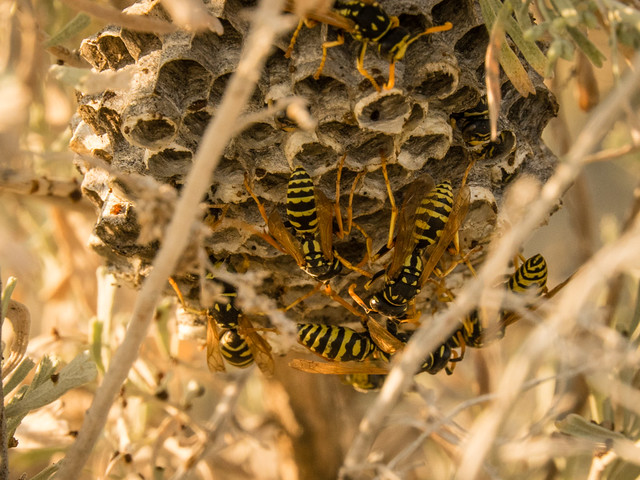
Paper wasps at nest

Nature Regina Field Trips
Sept. 23, 9 am-noon – Condie Nature Refuge
Check Nature Regina’s website for full details and updated information.

Saskatoon Nature Society Field Trips
Golden Eagles 
Sept. 21, 8 am – Fall Migration South of Delisle
Retirees and partners who are interested in birds and the natural world are invited to participate in Golden Eagle field trips.

A full list of upcoming events can be found on the EcoFriendly Sask Calendar 

In the News
Due to budget cuts to the Meewasin Valley Authority, Beaver Creek Conservation Area, Saskatoon, will be closed on weekends and holidays from October 2017 through to March 2018.

In its first year, the Saskatchewan Environmental Society's solar energy project on the roof of the Two Twenty supplied nearly a third of the building's energy and saved 20 tonnes of greenhouse gases.

Edmonton's mayor wants a section of the city's river valley to become a provincial park similar to Fish Creek Provincial Park in Calgary.

These cities are swooping in to save bats with bat fests and citizen bat enthusiasts.

Solar power and honey bees make a sweet combo in Minnesota.

From greening the operating room to energy and waste reduction - a climate action playbook for hospitals.

EcoSask News is a weekly round-up of local news and events. Email us if you have items you would like us to include. 

You can follow EcoFriendly Sask by liking us on Facebook, following us on Twitter, or by email (top right corner).

Tuesday, 21 February 2017

EcoSask News, February 21, 2017

Prairie dog

Upcoming Events
HABISask, Feb. 27 (webinar) 
Ben Sawa, SK Ministry of Environment, will be giving a webinar about the new online mapping application HABISask – Hunting, Angling and Biodiversity Information of Saskatchewan – on Feb. 27 as part of SK-PCAP's Native Prairie Speaker series.

Greater Sage Grouse, Mar. 1 (Mankota)
Beatriz Preito, SK Conservation Data Centre, will talk about non-intrusive methods for monitoring greater sage grouse at 7:30 pm, Mar. 1, in Mankota, as part of SK-PCAP's Native Prairie Speaker series.

SES Solar Co-op, Mar. 1 (Saskatoon) 
Jason Praski will provide an update on the activities of the Saskatchewan Environmental Society’s Solar Co-op at the Mar. 1 meeting of the Saskatchewan Energy Management Task Force.

Climate Change Resiliency & Hospitals, Mar. 2 (webinar) 
The Canadian Coalition for Green Health Care is offering a Climate Change Resiliency webinar on Mar. 2. Two Canadian hospitals will share what they are doing to ensure they are more resilient to the impacts of climate change.

Cultivating Food Security, Mar. 3 (Regina) 
Cultivating Food Security: How to Save Seeds & Grow Microgreens will take place from 6:30-9 pm, Mar. 3, at the Regina Floral Conservatory.

Climate Change Conversation, Mar. 4 (Pike Lake) 
Rosetown Elrose NDP is holding a climate change forum along with their AGM at Pike Lake on Mar. 4. Three panelists will discuss policy, passive home construction, and solar power.

Lead Green Associate Training, Mar. 4 (Saskatoon)
The U of S Office of Sustainability is offering a half-day Lead Green Associate Training on Mar. 4 with reduced rates for students. The course is designed to help students obtain certified knowledge of the green building industry.

Big Bike Adventure Hunt, Mar. 5 (Saskatoon) 
Bike Doctor Detours is hosting a bike adventure hunt on Mar. 5 for teams or father/daughter, mother/son duos.

Burrowing owls

Saskatoon Nature Society Field Trips
Feb. 25, 1-3 pm – Weir and City Park Birding
Mar. 4, 9 am-5 pm – Gardiner Dam Field Trip
Mar. 12, 1:30-5 pm – Pike Lake Birding
Check the Saskatoon Nature Society’s website for full details and updated information.

Nature Regina Field Trips 
Mar. 11, 10 am-noon – Wascana Winter Birds and Wildlife
Check Nature Regina’s website for full details and updated information.

A full list of upcoming events can be found on the EcoFriendly Sask Calendar 

In the News 
“When we subsidize roads, socialize the costs of pollution, crashes and parking, and even legally require that our communities be built in ways that make it impossible to live without a car, we send people strong signals to buy and own cars and to drive—a lot.”

“We’ve worked so hard to professionalize science, but then scientists became the elite and isolated. Now [science] is returning the power back to the public.”

Fleece microfibers make up 85 percent of beach pollution. But how you wash your clothes can change everything.

EcoSask News is a weekly round-up of local news and events. Email us if you have items you would like us to include. 

You can follow EcoFriendly Sask by liking us on Facebook, following us on Twitter, or by email (top right corner).

Thursday, 3 December 2015

Energy Savings in the Saskatoon Health Region


With 71 buildings. the Saskatoon Health Region is always on the lookout for ways to reduce utility costs and save energy without using patient dollars. Brian Berzola, Director, Facilities Management, and Doug Archibald, Manager, Energy Services, shared some of their triumphs and challenges.

Energy Performance Contract 
The Saskatoon Health Region (SHR) has just completed Phase I of an energy performance contract with Johnson Controls. Johnson Controls worked with Health Region employees to identify energy saving projects at Royal University Hospital that were guaranteed to save money. This guarantee from Johnson Controls permitted SHR to borrow the money needed to complete the projects and they’ll use the savings to pay back the loan.

The contract covers projects that will have a payback (total investment divided by annual savings) in 15 years or less.

Occupancy Controls 
Royal University Hospital is an older hospital. Large fans maintained a 24-hour air flow exchange, even in areas that were only used 8 hours a day, and consumed large amounts of energy. SHR has now installed electronic occupancy controls to ensure that the fans are shut off if the area isn’t in use on evenings and weekends.

Lighting 
Lighting throughout the hospital was reviewed and replaced with more energy-efficient lighting, either LED or T8 fluorescent light fixtures with electronic ballasts. LED lighting was chosen for exterior sites as well as hallways and public areas, while T8s were used in patient rooms that require a softer light.

When putting together an energy performance contract, the goal is to put together a package that not only pays off your investment but also leaves you with a surplus that can be put towards projects that you couldn’t otherwise afford.

The Health Region applied some of the surplus dollars to install full spectrum LED lights in the Mall. “We wanted to remove the doom and gloom and give more of a daylight experience,” Brian Berzola explains.

Insulation
Royal University Hospital is heated by steam purchased from the University of Saskatchewan. It comes across in huge pipes that can lose a lot of heat in transit. Jackets have now been installed to insulate the pipes and prevent heat loss.

Weatherstripping was also used to insulate doors and windows throughout RUH.

Steam Traps
Steam travels from the University to RUH and the condensate then makes the return journey to be reheated and reused. Steam traps capture the latent heat before the water is sent back. If they’re not tight, heat is lost. 100 steam traps were replaced and the Health Region anticipates a payback in just a couple of years.

“By replacing the steam traps, we reduce the amount of heat that we have to purchase and we reduce the need to cool the rooms where the steam was escaping,” Doug Archibald explains.

Water 
Low-flow toilets were installed throughout Royal University Hospital.


Additional Sustainability Projects 
The Health Region is looking at additional environmental sustainability projects which are outside the parameters of the energy performance contract.

Parking & Transportation 
Parking is hugely expensive to build and maintain. It’s also extremely complex. “We’re constantly trying to identify the right quantity of parking and to find the right balance between parking that is close to where people work (e.g. for night staff or a doctor delivering a baby) and further away for office staff who only work Monday to Friday. It’s also important to provide adequate handicapped parking.

The Health Region is working with the City of Saskatoon to identify other possibilities, such as park and ride or special buses that stop at the door of the hospital. “We’re always looking for ways to reduce congestion and demand on our parking lots,” Brian says.

Waste & Recycling
Medical facilities face a particular challenge when attempting to recycle and reduce waste. The Health Region has a small recycling program for some plastics, cardboard and paper, and batteries, and they’re interested in expanding the program to incorporate other items.

The biggest problem is medical waste as it has proven to be extremely difficult to ensure that medical waste is completely separated from other garbage or recycling. Medical waste is sent to Biomed Recovery & Disposal in Aberdeen for processing. They do their best to sterilize everything, but some material has to be incinerated.

Because it’s so hard to guarantee full separation, contractors are forced to immediately bury every load of waste that is removed from the Health Region.

Disposables vs. Reusables 
There is an ongoing debate regarding the use of disposable versus reusable items. Reusable items may, at first glance, appear to offer an energy savings; however, that isn’t always the case. Heating and sterilizing equipment uses a lot of energy, equipment, and people and poses an additional liability risk. Similarly, with a central laundry in Regina, the energy consumed in transportation must be factored in when considering cloth versus disposable paper gowns.

Chemicals & Infection Control
Infection control is of ongoing concern, and the Health Region currently uses quite a number of harsh cleaning chemicals to attempt to prevent the spread of disease. Brian Berzola is examining the potential of using UV lights to sterilize patient rooms and washrooms. Here are a few of the options: 

Patient Washrooms: A UV light can be installed over washroom doors with a motion sensor that is only turned on when the door is closed and no one is in the room. Once activated, it disinfects the whole room.

UV Light Stands: British Columbia is using portable UV light stands with 8 bulbs to sterilize patient rooms. Stands are set up in empty rooms and placed so that there are no shadows and every surface is exposed to direct light (even drawers are opened). Once they’re set up, you walk out of the room and turn on the lights by remote control. The room is completely sterilized. “It’s not cheap,’ Brian says. “Each sets of tubes costs approximately $100,000. In addition, the room must be empty, and we rarely have empty rooms.”

UV Light Scrubbers: UV light scrubbers can be mounted on the ceiling, directly above a patient’s bed. Fans draw the air up, and it travels through chambers where it is scrubbed clean before being put back into the room.

The Health Region is also investigating a long-lasting anti-microbial finish that can be applied to high-touch areas, such as tables and doorknobs. “It’s like Teflon,” Doug says. “Germs just slide off and are killed.”

Looking Ahead 
Brian and Doug emphasize that they work very hard not to divert dollars intended for patient care to energy projects. However, in the long run, energy savings and infrastructure improvements will lead to a safer, more comfortable patient experience. Let’s hope that the Saskatoon Health Region continues its search for ways to reduce energy consumption.

Additional Information 
Energy Performance Contracting Guide, Natural Resources Canada 
Ultraviolet Light Could Be Enlisted in Battle Against Hospital Infections

Photo Credit: Saskatoon Health Region