Showing posts with label Nature Conservancy. Show all posts

Tuesday, 30 November 2021

EcoSask News, November 30, 2021

Untitled

Upcoming Events 
One School One Farm is planning an online talk on carbon sequestration in shelterbelt trees at 7 pm, Dec. 7. 
Gardening at USask is offering the following online classes. All classes begin at 7 pm. 
Dec. 9 – Birds in Winter 
Dec. 12 – Insects in Your Garden: An Introduction to Beetles 

There will be a presentation on Saskatchewan’s woodland caribou at the 7:30 pm, Dec. 9, online meeting of the Saskatoon Nature Society. 

Martensville families are invited to make lanterns and take a walk to light up the night with Wildernook Fresh Air Learning at 5, 6:30 & 8 pm, Dec. 12. 

Full details on all events can be found on the EcoFriendly Sask Calendar 

Across the West
The “Trudeau government needs to clarify its competing objectives, with goals to reduce algae blooms while ramping up agricultural production, which will increase nutrient runoff … ‘Lake Winnipeg won’t wait and we need to get on with restoring (its) health.’” [Winnipeg Free Press

The Nature Conservancy of Canada has acquired 646 hectares of grasslands and wetlands located along the eastern shoreline of Chaplin Lake, the second-largest salt lake in Canada. During spring and fall migrations, thousands of shorebirds use Chaplin Lake and the surrounding grasslands to refuel or nest. [Toronto Star

“More than 70% of boreal woodland caribou herds in Canada are in decline, and recent analysis suggests that provincial exemptions allowing forestry and oil and gas activities in critical habitat have accelerated the trend.” [Pembina Institute

Farming the Future: Agriculture and climate change on the Canadian Prairies - a report on improving climate resilience while supporting local livelihoods. [International Institute for Sustainable Development

A “Victoria-based photographer and activist has spent much of the past 15 years searching for and photographing some of Canada's biggest, oldest trees … Most of the trees that Watt finds are slated to be cut down.” [CBC]
 
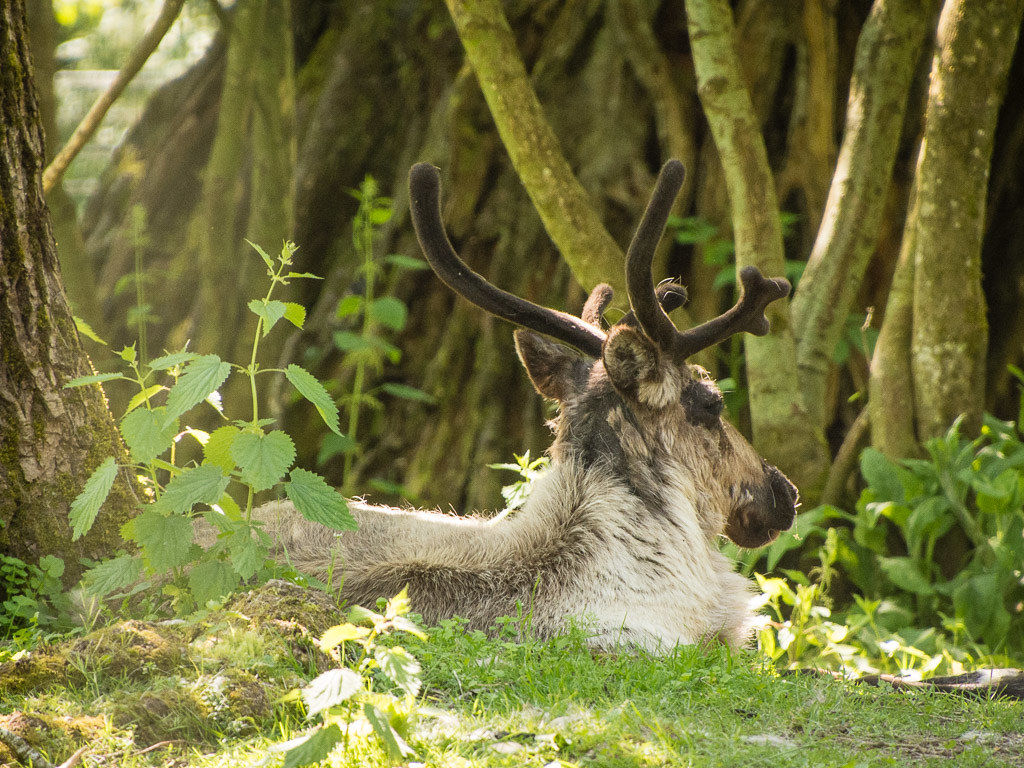
caribou / reindeer

Neighbourhood Planning 
“To create a circular and regenerative future, we should be looking at our neighbourhoods as fertile grounds of change, not merely as consumers of change decided elsewhere … Because the kind of transformative change needed doesn’t happen abstractly – out there – it happens here, in our houses, our offices, our streets, our river catchments, our institutions. And critically, change happens in our own ways of thinking and being … We need to be alert to context and not ask ‘what will work, generically?’ but ‘what will work and be right for this place and contribute to the bigger picture?’” [RSA

Durham Region’s green building practices are expected to “reduce greenhouse gas emissions, build infrastructure that is resilient to future climate change and create a healthier environment for residents.” [DurhamRegion.com

Choices 
“Economists recognize that congestion reflects underpricing: driving is so cheap that it becomes inevitable. You can have free roads or you can have free-flowing traffic but it is economically infeasible to have both.” [Planetizen

6 ways to make your flights greener and ecologically friendly. [Hand Luggage Only

Check out EcoFriendly Sask’s Nature Companion, a free nature app for Canada’s four western provinces


EcoFriendly Sask supports Saskatchewan environmental initiatives through an online publication, an events calendar, small grants, and the Nature Companion website/app. You can follow EcoFriendly Sask by liking us on Facebook, following us on Twitter, or subscribing by email (top right corner). 

Tuesday, 16 June 2020

EcoSask News, June 16, 2020

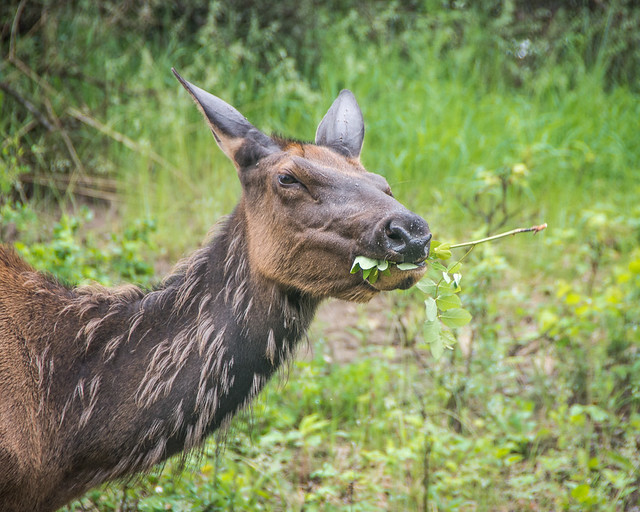
elk
 
Upcoming Events 
Ours to Save, Ours to Lose, June 18 (webinar) 
Join Dan Kraus, Nature Conservancy of Canada, as he discusses the plants and animals that are unique to Canada at 11:30 am (SK time), June 18. 

Summer Solstice, June 21 (Regina) 
You’re invited to gather on Wascana Hill to greet the sunrise and the beginning of summer at 4:45 am, June 21. 

Nature Sask AGM, June 22 (online) 
Nature Saskatchewan will be holding its annual general meeting online at 7 pm, June 22. 

Wildlife Research during a Global Quarantine, June 22 (webinar) 
Ryan Brook will discuss wildlife research during a global quarantine: tracking the rapid spread of invasive wild pigs during a noon-hour webinar on June 22. 

Group Excursion Leadership & Preparedness, June 23 (online) 
SaskOutdoors and Back40 Wilderness First Aid are hosting a webinar on group excursion leadership and preparedness from 7:30-8:30 pm, June 23. 

Women & the Energy Transition, June 23 (online) 
Pembina Institute is hosting a webinar panel discussion on the role of women in a changing energy economy from 11 am-12:15 pm (SK time), June 23. 

Sask River Basin AGM, June 24 (Saskatoon) 
The annual general meeting of Partners FOR the Saskatchewan River Basin will be held at 10 am, June 24. 

Carrot River Valley Watershed AGM, June 26 (Melfort) 
The Carrot River Valley Watershed Association is holding its annual general meeting at 1 pm, June 26, in Melfort. Email crwatershed@gmail.com by June 23 to register. 

Supporting Wild Bee Diversity, June 26 (webinar) 
Join SaskOrganics for a live webinar on supporting wild bee diversity on farms from 9:30-10:30 am, June 26. 

Zoo Training, June 29 (Saskatoon) 
The Saskatoon Zoo Society is looking for volunteer interpreters to help with their Wild Weekends programming. Find out more at the volunteer training session from 6-8 pm, June 29. 

Creating an Ecological Society, June 29 (webinar) 
This 2 ½ hour UK-based webinar on creating an ecological society will explore the relationship between social and ecological problems on June 29, 8-10:30 am (SK time). 

A full list of upcoming events can be found on the EcoFriendly Sask Calendar 

Local News 
Explore Regina's green spaces with self-directed guides from Nature Regina 

Nature Saskatchewan is asking residents to post sightings of burrowing owls 

Prince Albert’s plastic bag ban has been put on hold until the end of the current state of emergency 

Burrowing owl

From Information to Action
 
A Yukon First Nation plans to open a native plant nursery to support mine reclamation work 

Could cabbages, rapeseed, and sunflowers replace mining as a source of lithium, a key component of electronics and electric vehicles? 

Carbon-neutral coffee via wind power: “Sometimes long-distance transport is necessary for a balanced and sustainable supply chain, so sail cargoes have a role to play in that” 

We’re drowning in light: human beings, when faced with the availability of a cheaper and more efficient lighting technology, simply use more of it 

“Spending time with wild animals and plants, observing them, considering what they need to survive and thrive, exponentially expands our sense of family. . . . All of these plants and animals, these urban trees, sidewalk beetles, pearl-winged pigeons, are our neighbors” 


5 inventions illustrating the future of solar energy [10-minute video] 

Natural Wonders 

Parenting helps shape bigger brains – in jays, crows, and ravens 

The Big Bat Year – 29 countries, 396 species 

EcoSask News is a weekly round-up of local news and events. Email us if you have items you would like us to include. 

You can follow EcoFriendly Sask by liking us on Facebook, following us on Twitter, or by email (top right corner).
Thursday, 14 May 2020

Sarah Ludlow: Protecting the Prairie Habitat through Birds, Bats, and Fieldwork


Sarah Ludlow is the Conservation Science/GIS Coordinator for the Nature Conservancy of Canada -Saskatchewan (NCC). Sarah spent a lot of time in nature as a child and was always interested in identifying the wildlife she encountered, but it was an undergraduate class in ornithology that sparked a particular interest in birds. Sarah took a year off from university – but not from birds – after completing her Bachelor’s degrees in Biology and Geography. While working on bird-related fieldwork, Sarah thought, “Wouldn’t it be great if I could do something with all this data?” She headed back to university for a graduate degree researching the impact of oil and gas development on the density and reproductive success of grassland birds.

The fieldwork for her graduate degree involved two summers mapping the habitat, the number of birds, fledgling success rate, and nest survival on Antelope Creek Ranch, Alberta. Sarah and her team stayed on site for the entire season, sharing two RV campers. “There were a lot of really early mornings, getting up before sunrise to map the songbirds we saw and heard,” Sarah says. “Then we moved on to other components of the research.” The team established a 50-metre grid on each 300 x 600-metre study plot, moving slowly through the area, flushing the birds off their nests to count them and then going back to flag and monitor the nests. They also conducted habitat and vegetation surveys, mapping oil and gas infrastructure as well as the presence of crested wheatgrass. The research focused on songbirds – Savannah Sparrow, Vesper Sparrow, Baird’s Sparrow, Western Meadowlark, and Sprague’s Pippit – but Sarah obtained enough data to later analyze and put out a paper on ducks and shorebirds.


“We found enough nests to have robust, meaningful results,” Sarah says. The results showed that proximity to wells and roads was not a big factor in determining the birds’ density and reproductive success. However, in areas with a high percentage of crested wheatgrass, the Sprague’s Pipit nests didn’t do as well and had a lower survival rate. Areas with large amounts of crested wheatgrass had less plant diversity and fewer insects/arthropods than areas with abundant native grasses. As a result, there was less food available for the chicks and reduced nest survival.

After obtaining her Master’s degree, Sarah spent several years working for the Canadian Wildlife Service with fieldwork in the summer and data analysis and report-writing in the winter. She started working with the Nature Conservancy of Canada in 2015. She ran the volunteer program in her first year, moving on to the GIS position the following year and is now involved in broad-level planning for the Saskatchewan region while continuing the GIS work.

The Geographic Information System (GIS) provides a framework for presenting data visually and connecting it to a location (species density, for example). One of the first things the NCC does when buying a new property or establishing a conservation easement is to map the area. The map illustrates the conservation value of the property and serves as a baseline for future conservation work on the property.

Over the past few years, the NCC has devoted considerable attention to monitoring grassland songbird and bat populations on their properties. Songbird point counts on the larger grassland properties have been complemented by Sarah’s involvement with MAPS (Monitoring Avian Productivity and Survivorship) and BBS (Breeding Bird Survey). The MAPS program monitors breeding birds across Canada and the United States and is administered by the Institute for Bird Populations. It allows scientists to monitor the demographic parameters for species across their entire range and provides a snapshot of the local bird population. The BBS is a continent-wide program that began in the 1960s. It monitors population trends during the peak breeding season each year. Much of the work done to monitor bird populations is carried out by volunteers. “They’re passionate about bird conservation,” Sarah says. “Plus, it’s fun!”


As a science-based organization, the NCC uses the best available science to guide their management practices. However, there is limited data on bat populations in Saskatchewan. “It’s hard to protect habitat for a species if you don’t know what habitat it uses,” Sarah explained. “We want to find out where bats are roosting and what habitat they use, especially for the endangered myotis bats.” In the first phase of their research, the NCC hired a bat researcher to carry out acoustic monitoring. Over the past few years, recorders have been placed near water on over 12 properties. Based on the audio data, they can work out which species are present and their activity level and can then manage the properties to make it easier for the bats. A couple of the properties have shown really high activity levels for little brown bats. The NCC was also interested to find quite a bit of bat activity on several grassland properties: “There must be a reason they’re making the trip over open grassland to find water,” Sarah says.

The original acoustic monitoring of bats is now being supplemented by additional tracking of little brown and northern myotis bats on NCC’s properties at Nebo and Meeting Lake 3. They’re catching and putting tiny radio transmitters on bats, tracking them to where they roost, and then going back at dusk to count how many bats come out of the roost. NCC is also comparing the trees bats choose to roost in with other nearby trees to work out what the bats are looking for. The tracking has had to be put on hold this year as bat agencies don’t want any handling of bats as they’re concerned that Covid-19 could be transmitted to the bats.

Sarah says that the Nature Conservancy is making other programming changes due to Covid. Volunteer activities have been cancelled and staff will be following strict protocol when carrying out essential fieldwork. Sarah had hoped to band and monitor nestlings found in the nest boxes volunteers have put out over the last couple of years. But that won’t happen as the supply of bands is restricted to what organizations already have in stock. “It will be very collaborative,” Sarah says. “If I don’t need bands of a certain size, I’ll offer them to someone else who does.” Bird banding operations will also need to take precautions to protect both the banders and the birds from Covid-19. Measures will include maintaining physical distancing with people, ensuring only healthy banders handle birds, and extra sanitation of equipment.

Photo Credits
Photos 1 & 2 - Nature Conservancy of Canada
Photo 3 - Joseph Poissant

See Also 
Conserving Nature in Saskatchewan: Nature Conservancy of Canada
Prairie Beauty: NCC’s Dundurn Property

You can follow EcoFriendly Sask by liking us on Facebook, following us on Twitter, or by email (top right corner).

Tuesday, 7 April 2020

EcoSask News, April 7, 2020

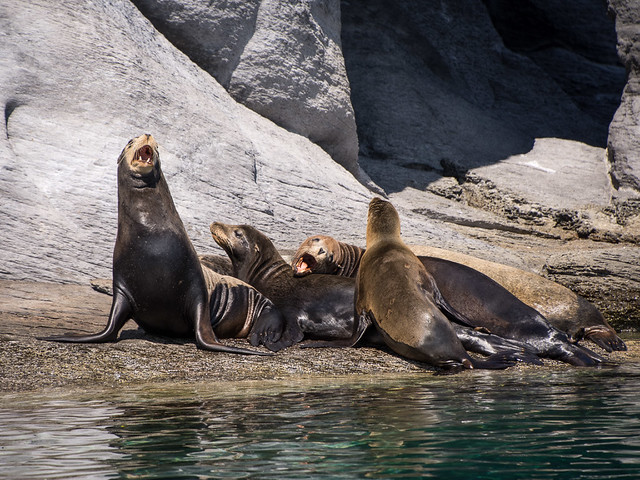
sea lions

Local News & Events
Changing the Climate, Apr. 11 (online)
Everyone is invited to join an online field trip from 1-3:30 pm, Apr. 11, in which U of R students share work from the multidisciplinary course, Engaging Climate Change: Creativity, Community, Intervention.

WILD Outside (Regina, Saskatoon)
WILD Outside, a national conservation-based youth leadership program designed for youth ages 15 to 18, is now recruiting for Saskatoon and Regina. Youth who join the program will explore the outdoors through a variety of activities (hiking, cross country skiing, and canoeing, to name a few) and plan and carry out community-based conservation action projects.

While COVID 19 currently prevents participants from gathering together in person, WILD Outside facilitators are adapting the programming to bring people together virtually across the country.

Go to http://wildoutside.ca/ for more information and to fill out the online inquiry form.


Buffalo Pound
The Nature Conservancy of Canada’s plan to protect shoreline and grasslands at Buffalo Pound is important for species at risk and water quality for surrounding communities.

Urban Wildlife
The Wildlife Rehabilitation Society of Saskatchewan is reminding the public that trapping and relocating wild animals is not a humane solution. “By relocating an animal, we are likely placing them in unfamiliar territory without any known food, water or shelter. Not only is this poor animal going to have to fight to find resources – it could be chased off, injured or killed by other animals whose territory they have been place upon! Don’t forget that there’s also the threat of diseases being spread when we relocate animals from one place to another. Bacteria, parasites and viruses can be easily spread and harm or kill a variety of wildlife. And what about babies? Often times, relocating an adult animal means that we are leaving behind helpless and orphaned baby animals who are unable to fend for themselves. Finally - relocating an animal just opens up the space for another animal to move right on in! We really aren’t solving any problems by forceably removing animals from their homes. We understand that wild animals can sometimes be a nuisance – especially if they are in your yard or house. However, we can help you find ways to make your area undesirable so the animal will naturally relocate itself! So please do not relocate any wild animals – give our hotline a call at 306-242-7177 and we’ll be happy to help!”

City birds: big-brained with few offspring or small-brained with a lot.

In the News
“What if concrete could be used to store climate-warming carbon?”

Lockdowns are changing the way the earth moves, making it easier to monitor for earthquake and volcano activity.

sea lion

Online Resources
From flying foxes to sea lions – nature cams bring nature to your screen.

Want to visit the world’s largest cave or head inside an active volcano – the 10 best natural wonders’ virtual tours.

That’s Amazing!
Squids communicate in the dark ocean by turning their bodies into animated message boards.

Peacock spiders are famous for their rainbow-hued buttocks, elaborate mating dances, and ninja-esque jumping skills.


EcoSask News is a weekly round-up of local news and events. Email us if you have items you would like us to include. 

You can follow EcoFriendly Sask by liking us on Facebook, following us on Twitter, or by email (top right corner).
Tuesday, 16 October 2018

EcoSask News, October 16, 2018

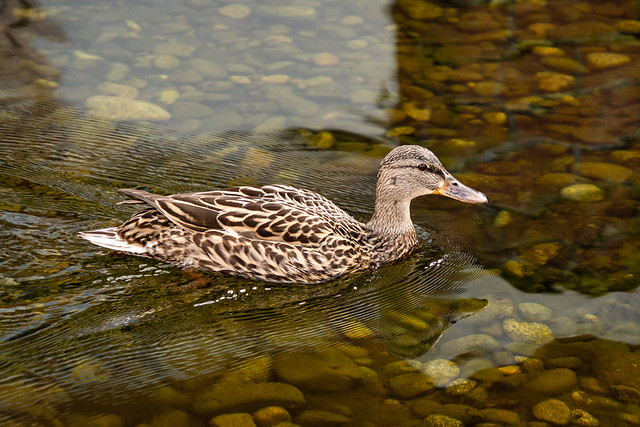
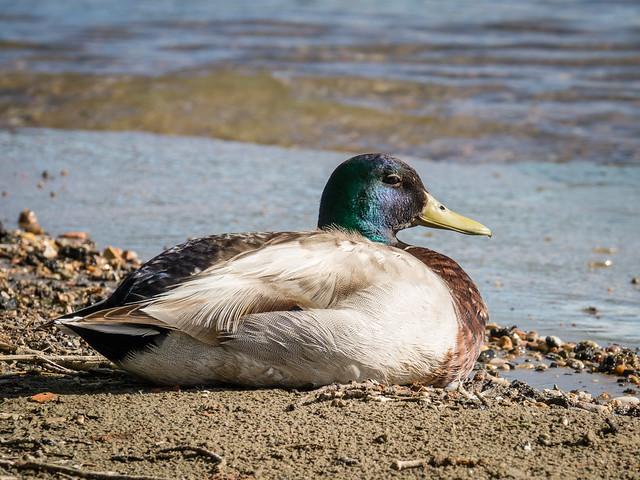
Mallard duck (female)

Upcoming Events
Smarter Science, Better Buildings, Oct. 15-Nov. 12 (Yorkton) 
Grade 7 students in Yorkton can visit the Smarter Science, Better Buildings exhibit at the Western Development Museum from Oct. 15-Nov. 12.

Let’s Make Regina 100% Renewable, Oct. 16 (Regina) 
Regina's Blue Dot Movement and some of Regina's City Councillors are hosting a panel discussion on making Regina 100% renewable by 2050 from 7-8:30 pm, Oct. 16.

Car Seat Recycling, Oct. 17 (Regina & Saskatoon) 
Take advantage of a one-month pilot project to recycle infant seats, convertible seats, and booster seats in Regina and Saskatoon starting Oct. 17.

Nature Immersion Walks, Oct. 18 & 19 (Saskatoon) 
Participate in a nature immersion walk from 1-3 pm, Oct. 18 or from 1-3 pm, Oct.19.

Sustainability on Campus, Oct. 19 (Saskatoon) 
Join the U of S Office of Sustainability from 12-1 pm or over a pint at 5 pm, every third Friday of the month.

Repair Cafés, Oct. 20 (Prince Albert & Saskatoon)
Bring your broken things to be mended at Repair Cafés in Prince Albert and Saskatoon:
     Prince Albert - 1-4 pm
     Saskatoon - 10 am-4 pm


Mallard duck

Seed Saving Workshop, Oct. 23 (Prince Albert) 
Join the Prince Albert Permaculture Guild at 7 pm, Oct. 23, as they package seeds for the Prince Albert Seed Library.

Nature and Me, Oct. 24 (Regina) 
Join Nature Conservancy of Canada at 7 pm, Oct. 24, for a discussion about our complicated relationship with nature and how it stands to impact our future. Obtain a 40% reduction when you register with the promo code NCCFRIENDS.

Standing Rock, Oct. 24 (Regina) 
Cinema Politica Regina is showing two films about Standing Rock at 6:30 pm, Oct. 24.

Sustainability Lunch & Learn, Oct. 24 (Regina) 
Learn about the City of Regina’s recycling and waste reduction/diversion plans at a lunch & learn at Innovation Place at 12 pm, Oct. 24.

Hallowe’en Nature Program, Oct. 27 (Regina)
Kids will enjoy meeting live animals and making spooky discoveries at the Wascana Spooktacular, 12-3 pm, Oct. 27.

Dark Skies at the Creek, Oct. 27 (Saskatoon) 
Celebrate International Bat Week at the Beaver Creek Conservation Area from 12-5 pm and from 6:30-11 pm, Oct. 27. Meet some nocturnal animals and view the night sky. Book your spot now for the evening event as registration is limited.

A full list of upcoming events can be found on the EcoFriendly Sask Calendar 

Birds of Saskatchewan 
Birds of Saskatchewan by Alan R. Smith, Stuart C. Houston, and J. Frank Roy is now available from Nature Saskatchewan. The 800-page, full-colour book provides a comprehensive compendium of Saskatchewan’s birds. Receive a discount by purchasing before December 15.


In the News 
Cowessess First Nation solar and wind power site is expected to generate up to 400 kilowatts of renewable energy

Differing opinions on the cause of Quill Lakes flooding are delaying a solution

Canada should prioritize land conservation in high-priority regions (as illustrated) and promote connectivity

New technologies make it easier to reduce energy demand at peak times

Dismantling buildings piece by piece to preserve the reusable parts keeps materials out of landfills and creates more jobs than demolition 

Reduction of hydrofluorocarbons could buy us time until carbon emissions are brought under control

EcoSask News is a weekly round-up of local news and events. Email us if you have items you would like us to include. 

You can follow EcoFriendly Sask by liking us on Facebook, following us on Twitter, or by email (top right corner).

Tuesday, 11 September 2018

EcoSask News, September 11, 2018

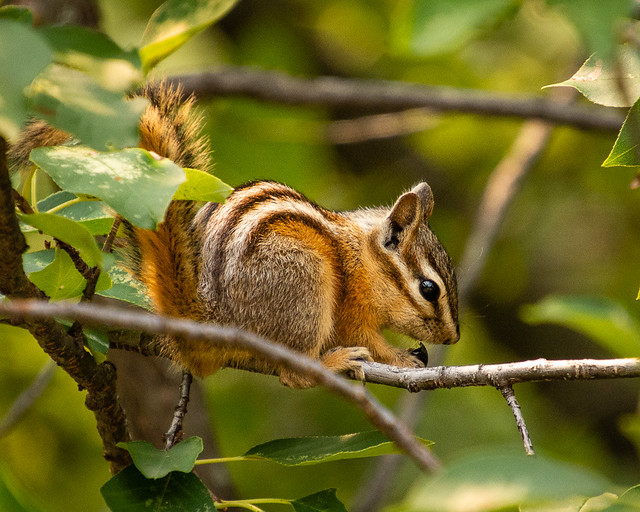
chipmunk

Upcoming Events
Guided Nature Immersion Walks, Sept. 10 & 14 (Saskatoon)
Participate in a nature immersion walk with Dolores Burkhart on Sept. 10 at 1 pm and Sept. 14 at 10 am.

The State of the Lakes, Sept. 14 (Fort Qu’Appelle)
Dr. Peter Leavitt will present his 25 years of data regarding the Qu’Appelle River Valley Watershed at the Treaty 4 Gathering at 6:30 pm, Sept. 14, in Fort Qu’Appelle.

Wild Ecol Seminar, Sept. 14 (Saskatoon)
The WildEcol seminar series is held at 3:30 pm, every other Friday, on the U of S campus:
Sept. 14 – Ecological factors driving the population biology of King Eiders

No Justice, No Adaptation, Sept. 15 & 16 (Saskatoon)
Suha Jarrar will discuss the politics of climate change in Palestine at 6 pm, Sept. 15,  and at 10:30 am, Sept. 16, in Saskatoon.

Walking Saskatoon, Sept. 16 (Saskatoon)
Everyone is invited to attend Walking Saskatoon’s meeting from 1-3 pm, Sept. 16.

Word on the Street, Sept. 16 (Saskatoon)
Paul Hanley and Trevor Herriot will be reading from their latest books at Word on the Street, Sept. 16.

Saskatchewan Owls, Sept. 17 (Regina)
Kim Mann will talk about Saskatchewan owls at the Nature Regina meeting, 7:30 pm, Sept. 17.

Fruit for the Birds, Sept. 18 (Saskatoon)
Find out which birds love eating fruit and which plants appeal to them the most at 7 pm, Sept. 18, at Wild Birds Unlimited.

Tyzzer’s Disease, Sept. 20 (Saskatoon)
Gary Wobeser will discuss the fascinating history and people in the study of Tyzzer’s disease at the Saskatoon Nature Society meeting, 7:30 pm, Sept. 20.


Looking Ahead
Nature Photography (Regina, Saskatoon)
One way to enjoy and share the beauty of the natural world is through photography. Both the Saskatoon Camera Club and the Regina Photo Club offer a varied program, including field trips.

Star-Gazing (Regina, Saskatoon)
Both the Regina and Saskatoon centres of the Royal Astronomical Society of Canada offer a monthly program. Check their websites for program information. Saskatoon also has a youth astronomy club.

Rollin’ It Up, Sept. 22 (Regina)
Help the Nature Conservancy of Canada remove old fencing and install bat houses on their Edenwold property on Sept. 22.

Canoe Certification Course, Sept. 29-30 (Regina)
SaskOutdoors is hosting a Paddle Canada canoe certification course in Regina Sept. 29-30.

Junior Nature Sketch Club, Sept. 29-Nov. 3 (Saskatoon)
Kids ages 5-12 are invited to join Junior Nature Sketch, an outdoor nature program that focuses on sketching and observing wildlife habitats.

Adult Nature Sketch Club, Sept. 29-Nov. 3 (Saskatoon)
Observe and sketch in wildlife habitats as part of the 5-week Adult Nature Sketch program.

Permaculture Design Course, October-April (Regina)
Edible Landscapes Permaculture Design & Consulting is offering a permaculture design certification course over 6 weekends from October to April in Regina. Registration deadline is Sept. 30.

A full list of upcoming events can be found on the EcoFriendly Sask Calendar 

In the News
An interview with Passive House pioneer Harold Orr.

Soil is filled with more biological diversity than any other habitat on Earth - here are some of the organisms that keep our soil healthy.

Wildlife corridors aren't a complete solution - generational knowledge isn't easily replaced.

Edward Burtynsky's new book records human changes to the planet.

When traffic-clogged highways are expanded, new drivers quickly materialize to fill them. Here’s how “induced demand” works.

George Monbiot refuses to believe that a better form of consumerism will save the planet.

EcoSask News is a weekly round-up of local news and events. Email us if you have items you would like us to include. 

You can follow EcoFriendly Sask by liking us on Facebook, following us on Twitter, or by email (top right corner).


Tuesday, 21 August 2018

EcoSask News, August 21, 2018

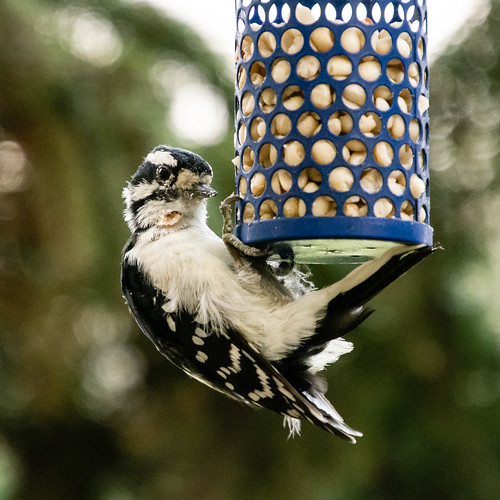
Downy woodpecker

Upcoming Events 
Curbside Recycling Survey, Aug. 1-Sept. 15 (Yorkton)
The City of Yorkton is asking for feedback on its curbside recycling program. Respond online before Sept. 15.

Save the Sage Grouse, Sept. 8 (Val Marie) 
Help the Nature Conservancy of Canada maintain their Wideview property on Sept. 8 by making the fencing more wildlife friendly.

Repair Café Prince Albert, Sept. 8 (Prince Albert) 
Share and learn skills to fix personal and household items at Repair Café Prince Albert from 1-4 pm, Sept. 8.

Curbside Swap, Sept. 8 (Saskatoon) 
The City of Saskatoon is hosting a Curbside Swap on Sept. 8 so unwanted items can find a new home rather than being thrown out.

Looking Ahead
Rob Dumont Energy Management Awards Dinner, Oct. 15 (Saskatoon) 
The 2018 Rob Dumont Energy Management Awards Dinner will be held on Oct. 15. Tickets are available on Picatic.

Build Sask Green 2018, Oct. 18 (Saskatoon) 
The Build Sask Green conference will be held in Saskatoon on Oct. 18 and will include sessions on zero carbon building standards and applications.

A full list of upcoming events can be found on the EcoFriendly Sask Calendar 

In the News
City of Regina is watering plants using a tricycle equipped with a water tank and solar panel

Mayor Charlie Clark believes Saskatoon has an opportunity to show leadership on climate change and young people will play an important role [video]

Members of the Canadian Association of Physicians for the Environment believe that Canada - and Canadians - need to wake up and smell the smoke

Fracked oil and gas wells pump out huge volumes of polluted wastewater

This is a great example of the power of citizen science - an 11-year-old halts the flow of illegal sewage into a Nova Scotia river

10 ways to participate in the sharing economy

In Case You Missed It
Saskatoon’s urban forest was in the news this week. Here’s an article we published about Saskatoon’s trees in 2016.

If you like the idea of living in a batty neighbourhood, be sure to read 8 cool facts about bats

Fall bird migration is underway. Here are some tips for bird-proofing your windows

As the days get shorter, give some thought to the impact of light pollution on humans and animals

EcoSask News is a weekly round-up of local news and events. Email us if you have items you would like us to include. 

You can follow EcoFriendly Sask by liking us on Facebook, following us on Twitter, or by email (top right corner).
Thursday, 16 August 2018

The Rise of Citizen Scientists

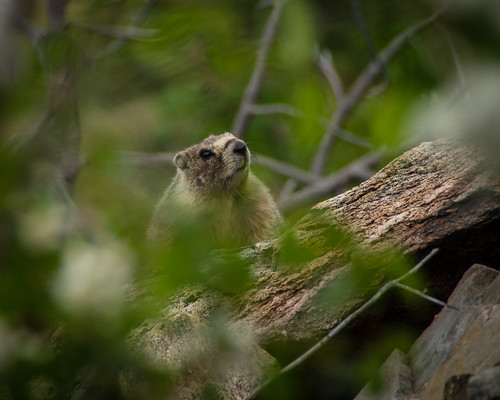
marmot


“My seven-year-old loved this [Sask Parks bioblitz].She logged 41 observations and loved getting feedback from people and learning what things were. Can’t wait to do this again next year!” (EcoFriendly Sask Twitter feed) 

Do you like to dig in the dirt or would you rather scan the sky for birds? Do you like solving puzzles on the computer or wonder what is happening in your backyard overnight? All these opportunities and more are available every day as the public is invited to assist scientists in collecting and processing data and working on conservation projects.

Eyes and Ears
For more than 25 years, observers have provided Plant Watch Alberta with over 55,000 records of when plants start to flower. Many of those volunteers have been involved for over 10 years providing valuable indicators of variations in the weather and the risk of early spring wildfires before the forests turn green.

In 2017, the Royal Saskatchewan Museum held one-day bioblitzes in Regina and Cypress Hills. With 665 observations of 239 different species, the Regina bioblitz provided baseline data on the species that inhabit the area. There were some exciting discoveries in Cypress Hills where volunteer plant experts identified a number of mosses and liverworts that were either new to Cypress Hills or new to Saskatchewan.

Very little is known about Calgary’s frogs, toads, and salamanders. Calgary residents enjoying a walk along the Rotary Mattamy Greenway can help by using a newly developed app, Call of the Wetland, to identify and report when they either hear or see one of these amphibians.

Citizen science projects recognize the value of local knowledge, which can supplement and guide scientific research. The LEO network in Alaska “is a network of local observers and topic experts who share knowledge about unusual animal, environment, and weather events.”

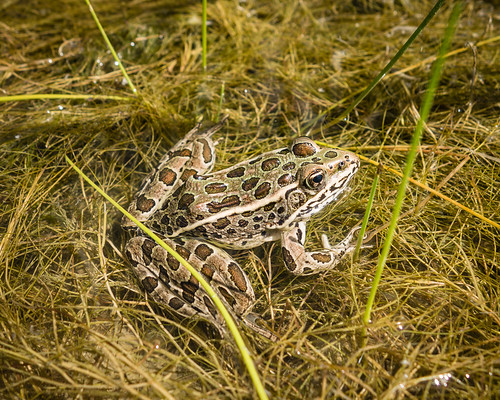
Northern Leopard frog

Practical Applications
Many citizen science projects have a practical purpose. Residents living near Heathrow Airport in London, England, installed devices in their homes and gardens to record noise and its impact on people and wildlife. The data was shared with local authorities and fed into the consultation process for a third runway.

Over 4500 wildlife observations in BC’s Crowsnest Pass are being used to build support for a wildlife corridor and will assist in planning a future highway expansion. A project tracking wildlife crossings and collisions along the Nova Scotia-New Brunswick border hopes to reduce the number of animals killed on the roads in that area.

Biologists, agencies, and communities involved in Grupo Tortuguero not only collected data on local turtle populations but also assisted in establishing marine protected areas and sustainable fishing practices.

road through snowy trees

Remote Control
You don’t need to be physically present to help collect data. A University of Wisconsin biologist who tracks deer, bears, and other large animals distributed thousands of motion-sensitive cameras to teachers, students, landowners, and nature-lovers. "By working with citizen scientists who put out these cameras on their own private property, we're now able to characterize areas that we wouldn't otherwise be able to go into," he says.

Soundscapes to Landscapes is mapping bird diversity in Sonoma County, California. Volunteers distribute and collect sound recorders around the area. Experts then train computers to identify the different songs, whistles, and squeaks that have been recorded.

You can be a citizen scientist from the comfort of your own home. Calgary Captured is looking for volunteers to identify the animals in photos taken by motion-activated cameras in 12 city parks. Zooniverse labels itself as people-powered research and hosts a wide variety of projects – count cells in modern and fossil leaves, classify galaxies according to their shape, or transcribe natural history museum data to make it more accessible.

Muscles
Sometimes eyes and ears aren’t enough. Conservation organizations need your muscles. You can plant sagebrush to provide nesting cover and winter forage for greater-sage grouse at Grasslands National Park or work with scientists from Calgary Zoo on the Canadian Prairie Dog Ecosystem Research Project. Volunteers with the Native Plant Society of Saskatchewan dig out invasive flowering rush, while conservation volunteers with the Nature Conservancy of Canada help tear down or repair fences, install bird boxes, and clean up shoreline debris. Volunteer gardeners are gathering every Thursday morning to whip the Native Plant Garden at Regina’s Royal Saskatchewan Museum back into shape.

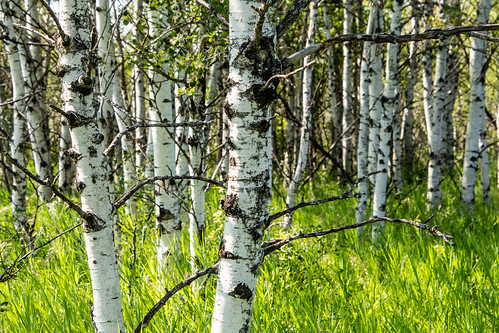
Aspen grove and smooth brome

Personal Benefits
Volunteering your time to help with a science project can generate huge personal benefits. Meghan Mickelson participated in a bioblitz at Nature Conservancy of Canada’s Dundurn property earlier this year. She says, “There is magic in discovering a new area: you never know what is around each bend or behind each grove of trees. . . . I love exploring, taking photos of flowers, bugs and the land.”

Tony Iwane started contributing photographs to iNaturalist when he retired. He says, “There is no question that iNat has changed the way I interact with the natural world. I find that now instead of just assessing whether something is ‘pretty’ or not, I’m much more inclined to stop and watch. I have much more respect for the natural world…There is nothing scientific about what I do, I just have a love of nature which iNat has flamed into an obsession! I now get triple enjoyment from the things I see, firstly the sighting, then working through the photos, and finally, sharing the observation with people who are interested. I value the identifications, the information available, and the fact that in some small way I may be helping.”

Tuesday, 24 July 2018

EcoSask News, July 24, 2018

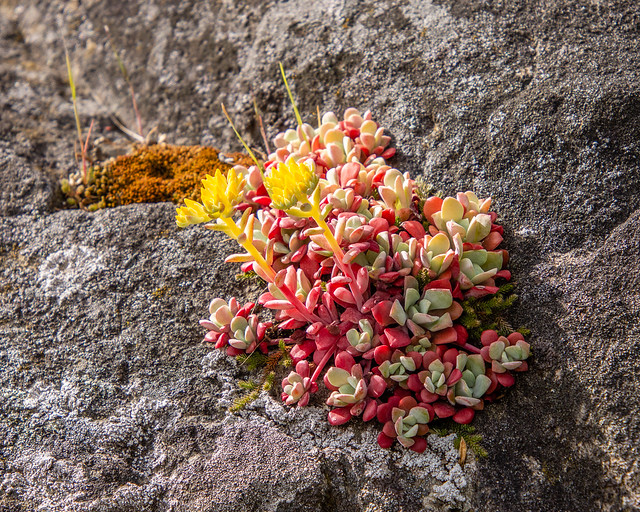
stonecrop

Upcoming Events
Mending Meet Up, July 28 (Saskatoon)
Library of Things is holding a Mending Meet Up from 1-4 pm, July 28.

Northern Leopard Frog Project, July 31 (webinar)
Kimberly Pearson will discuss the northern leopard frog project in Waterton Lakes and Grasslands National Parks in a noon-hour webinar on July 31.

Free to be Me Animal Sanctuary, Aug. 1 (Moose Jaw)
Kids ages 6-10 are invited to join the Moose Jaw Public Library’s trip to Free to be Me Animal Sanctuary from 2-4 pm, Aug. 1.

Beyond the Big Dipper, Aug. 11 (Grasslands National Park)
View the stars and learn more about them from Royal Astronomical Society volunteers at Grasslands National Park on Aug. 11.

Looking Ahead
Conservation Expo, Sept. 6 (Regina)
The Saskatchewan chapter of The Wildlife Society is holding a conservation expo and networking event on Sept. 6 in Regina. Poster presentation title submissions must be sent in by Aug. 15.

Building Enclosures for High Performance Buildings, Nov. 15 (Saskatoon)
Building Enclosures for High Performance Buildings is a one-day course being offered by Passive House Canada in Saskatoon on Nov. 15.

Nature Conservancy Volunteer Opportunities
Help the Nature Conservancy of Canada maintain their properties by volunteering at one of their August events.

Aug. 11Campout for Conservation at Old Man on His Back – Clean up the bison handling facilities, repair fences, and build, repair, and install Ferruginous Hawk nest platforms.

Aug. 25Keeping it Clean at Shoe Lake – Remove shoreline debris from the Shoe Lake saline marsh.

A full list of upcoming events can be found on the EcoFriendly Sask Calendar

In the News
Wascana Solar Co-operative and the Regina Catholic School Division are in talks about a joint project that would see solar panels put on the roof of Miller Comprehensive Catholic High School.

Thoughtful recommendations from the Saskatchewan Environmental Society on addressing climate change.

Farmers are very concerned about damage to their land following Husky’s salt water leak.

The United Church of Canada plans to reduce emissions by 80% by 2050. The initial focus is on energy efficiency and building retrofits. [video]

When we subsidize roads . . . make it impossible to live without a car, we send people strong signals to buy and own cars, and to drive... a lot.

Wide arterial roads designed for heavy traffic usage (such as 22nd Street in Saskatoon) don't have to be death traps for pedestrians.

EcoSask News is a weekly round-up of local news and events. Email us if you have items you would like us to include. 

You can follow EcoFriendly Sask by liking us on Facebook, following us on Twitter, or by email (top right corner).
Thursday, 19 July 2018

Prairie Beauty: NCC's Dundurn Property

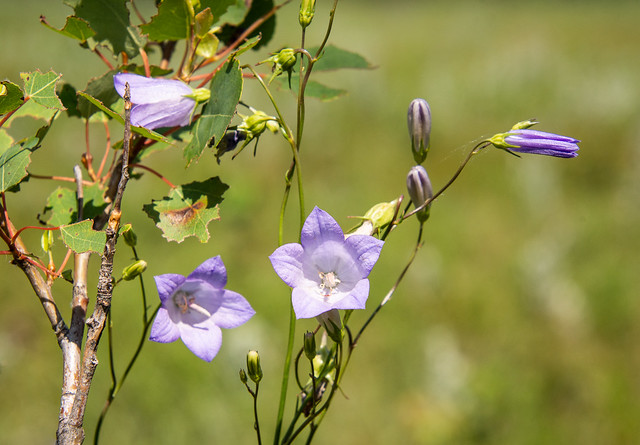
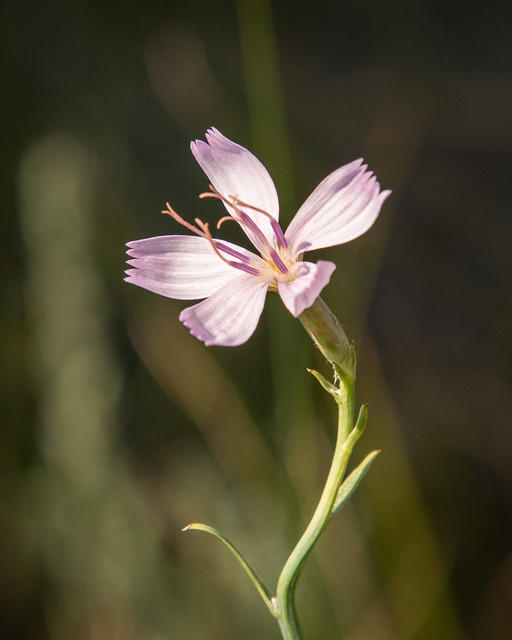
Harebell

As we bump our way down a leafy lane, a white-tailed deer pokes its head out to see who’s come to visit. Verity Moore-Wright, Acting Director of Development, and Ryan Dudragne, Conservation Science Co-ordinator – LIS, have invited us (Andrew and Penny McKinlay) to join them on a hike around one of the Nature Conservancy of Canada’s newest properties near Dundurn.

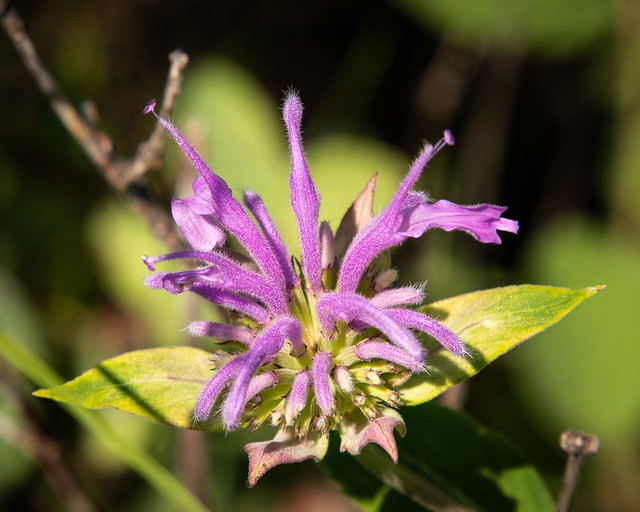
Rolling hills – stabilized sand dunes – stretch out to a clear blue sky. A red-tailed hawk soars overhead and there are treasures to be found at our feet. A patch of wild bergamot is flowering near the entrance to the property attracting long-tongued bees, bee flies, butterflies, and moths. Wasps may steal the nectar by drilling a hole in the nectar tubes.

Bergamot

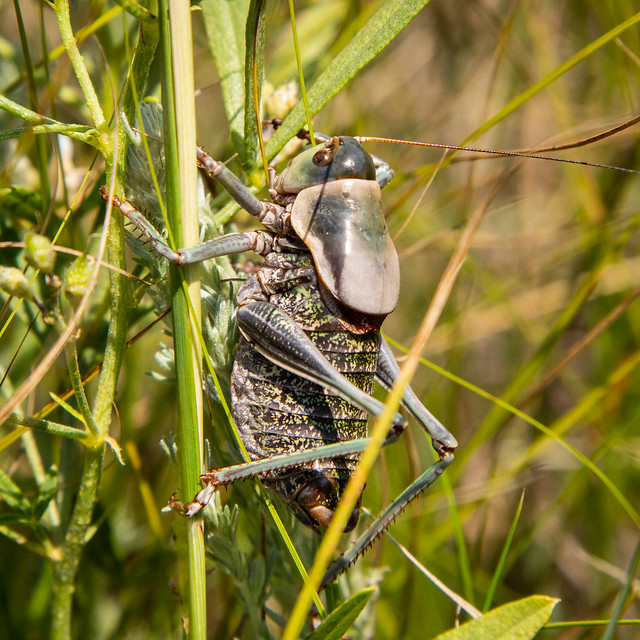
We’re delighted to spot a hunch-backed Mormon cricket. It’s not a cricket at all but a shield-backed katydid. Although they have no wings, they can travel up to 2 km a day when they’re swarming, heading out in the thousands to find food.

Mormon cricket

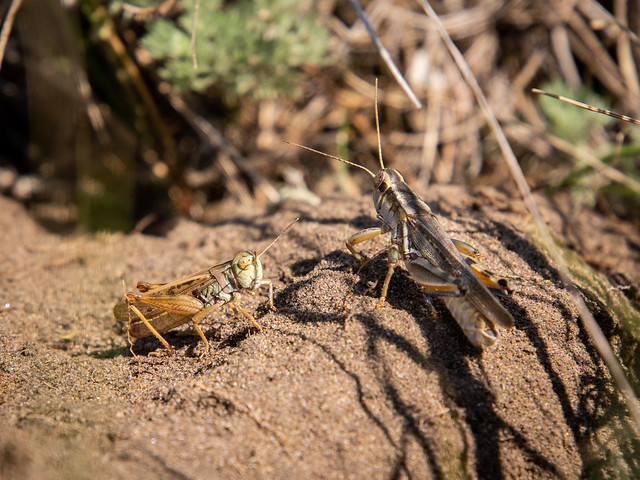
There are plenty of other grasshoppers and katydids. We tend to think of grasshoppers as pests, but only a few of them destroy crops. There is such variety in their sizes, colors, and patterns.

grasshoppers

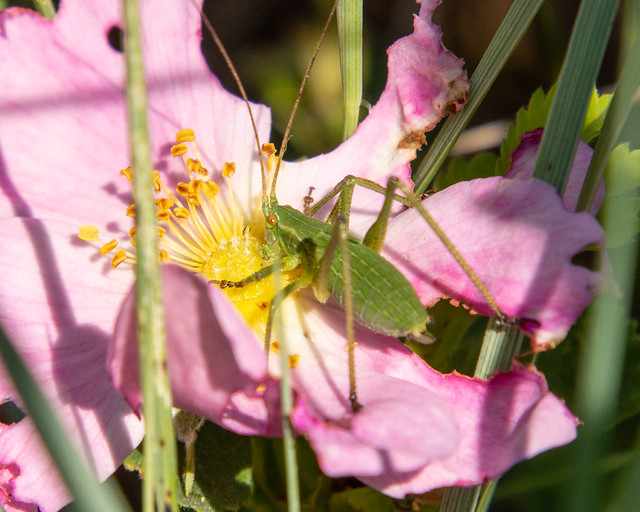
We weren't initially able to identify the following insect, but, with help from iNaturalist, we now know it's a Broad-winged Bush Katydid (scudderia pistillata) late instar nymph.

insect on wild rose

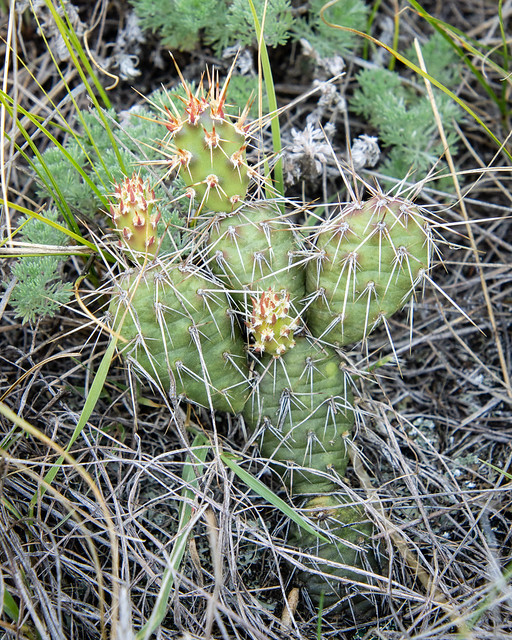
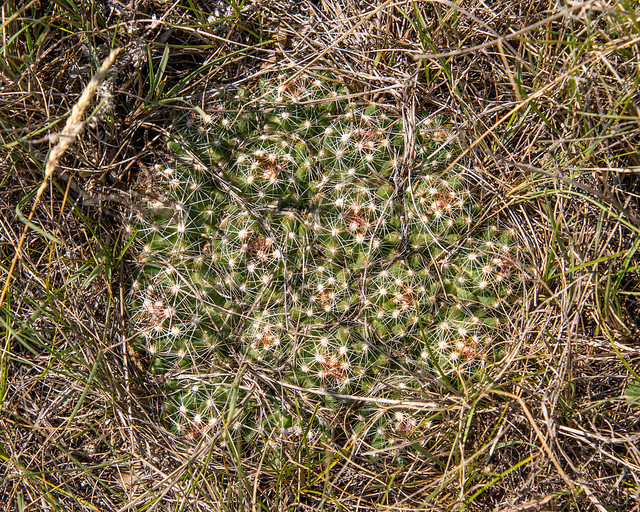
We need to watch where we step as there are plenty of cactus – both pincushion and prickly pear.

Prickly-pear cactus

pincushion cactus

The rush skeleton plant, with next to no leaves, is another plant that can tolerate dry conditions.

Rush skeleton plant

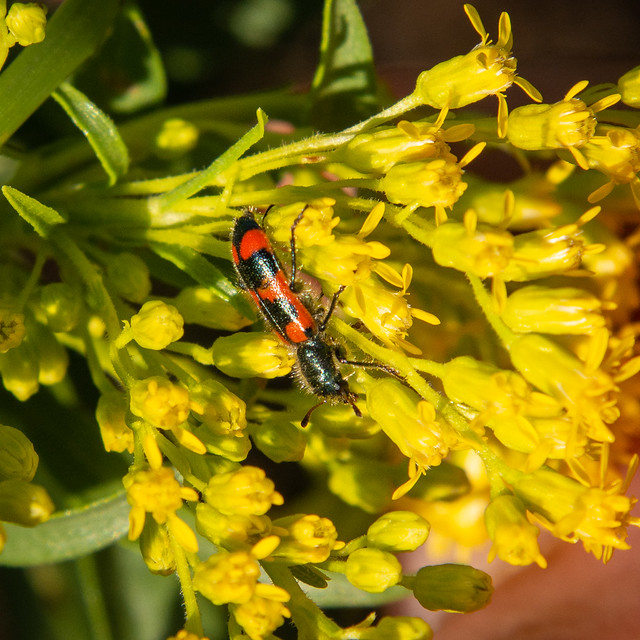
The red-blue checkered beetle stands out against the goldenrod’s bright yellow flowers. Pollen will stick to the long hairs on its body and legs and be passed along to other plants.

Red-blue checkered beetle on low goldenrod

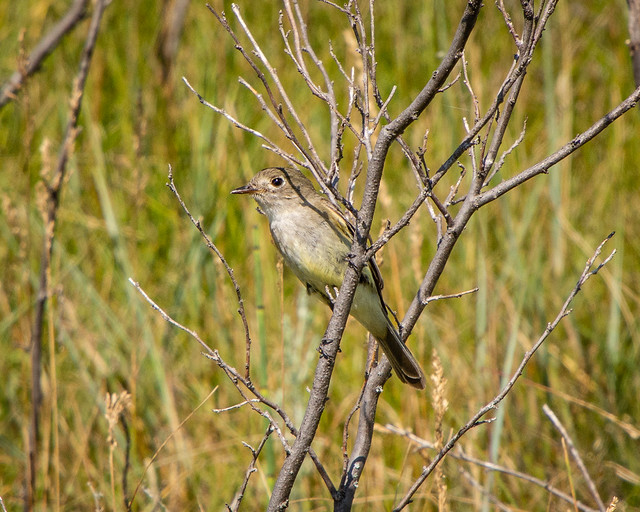
A flycatcher keeps a close eye on us as we pass by, but many of the site’s inhabitants are harder to spot. They do, however, leave us clues – moose poop (these guys are part of Ryan Brook’s Saskatchewan Farmland Moose Project), a freshly dug badger hole, heaps of loose dirt left behind by pocket gophers. If you look really closely at the loose dirt, you’ll spot small round holes indicating the homes of tiger beetles. Ryan describes them as predatory bullies, dragging other insects into their hole or chasing them down.

Alder Flycatcher (?)

We’re hot and hungry after a long walk around the property but very grateful to Nature Conservancy of Canada for inviting us out to see the site and for the important work they do in protecting natural areas and maintaining biodiversity. And a special thank you to Ryan who was so helpful in identifying all the fascinating species we were fortunate enough to spot.

For more information about the Dundurn site and the work of the Nature Conservancy, take a look at the article we posted in May.

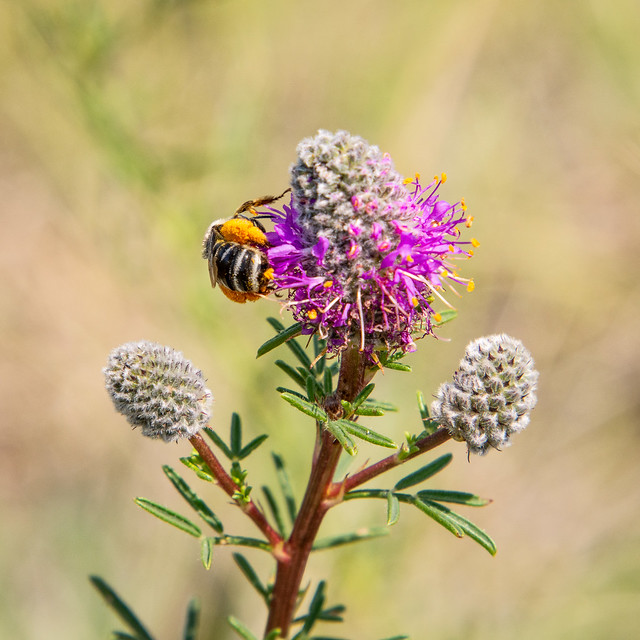
bee on purple prairie clover

Tuesday, 10 July 2018

EcoSask News, July 10, 2018

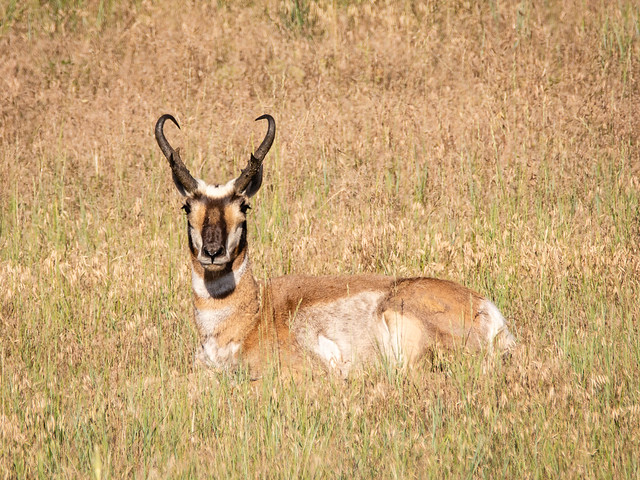
solitary male pronghorn

Upcoming Events
Household Hazardous Waste Day, July 14 (Saskatoon)
You can dispose of household hazardous waste in Saskatoon from 8 am-2:30 pm, July 14.

Go! Science, July 19 (Swift Current)
Kids in grades 1-6 are invited to attend interactive science activities presented by the Saskatchewan Science Centre from 1-4 pm, July 19, at the Swift Current Branch Library.

U of S Lunch & Learn Series, July 20 (Saskatoon)
Join the U of S Office of Sustainability from 12-1 pm, every third Friday of the month, for presentations and discussions on sustainability.

U of S The Fix, July 20 (Saskatoon)
Join the U of S Office of Sustainability and university sustainability professionals over a pint at 5 pm, every third Friday of the month, to fix some of sustainability’s most complicated issues.

Healthy Planet, Healthy Life, July 23-27 (Regina)
Kids ages 5-12 are invited to discover the technology scientists use to measure changes to the environment at the July 23-27 Regina Public Library program presented by the Saskatchewan Science Centre.

Looking Ahead
The Dammed Rivers, Oct. 1-3 (Saskatoon)
Partners FOR the Saskatchewan River Basin in collaboration with the Canadian Water Resources Association will hold their annual conference Oct. 1-3 in Saskatoon. The conference will bring together experts from many fields related to the existence of dams. Early bird registration until Aug. 31.

Environmental Law Toolkit Workshop, Oct. 2 (Toronto)
The Sustainability Network is offering a 1-day workshop on Oct. 2 in Toronto on the legal tools available to protect our air, water, land, and human health.

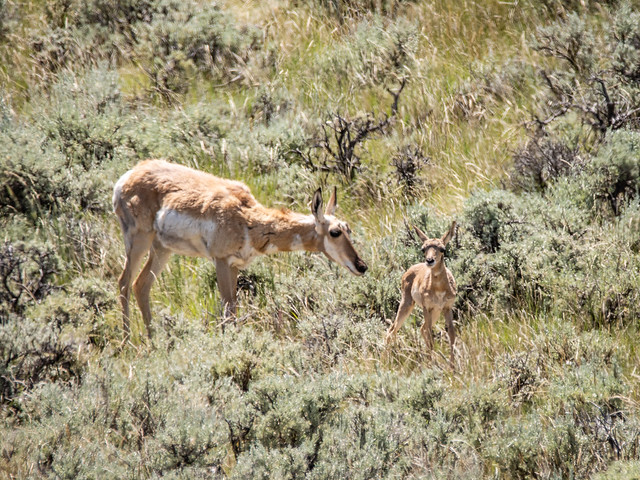
pronghorn and fawn

Saskatoon Nature Society Field Trips
Golden Eagles
July 19, 8 am – Gabriel Dumont Park
Aug. 9, 8 am – Shorebirds and Early Migration
Retirees and partners who are interested in birds and the natural world are invited to participate.

Other Saskatoon Nature Society Field Trips 
July 14, 10 am-1 pm – Botany Trip to Beaver Creek Conservation Area
July 22, 1:30-4:30 pm – Dragonfly Field Trip
July 28, 9 am-12 noon – Shorebird Driving Trip
Aug. 11, 8:15 am – Douglas Park Sand Dunes Hike
Check the Saskatoon Nature Society’s website for full details and updated information.

A full list of upcoming events can be found on the EcoFriendly Sask Calendar 

In the News
Nature Conservancy of Canada has purchased 335 acres of native grasslands and natural wetlands in the Upper Qu’Appelle Natural Area close to Craven. The Natural Area is home to a number of species at risk, included Sprague’s Pipit, Chestnut-collared Longspur, and Baird’s Sparrow.

Lead poisoning from fishing tackle kills loons.

5 tips for having fun birding with kids.

Want to live a more sustainable life? Individual choice isn’t enough - you have to change the system.

What trash on Everest can teach us about tackling problem waste.

EcoSask News is a weekly round-up of local news and events. Email us if you have items you would like us to include. 

You can follow EcoFriendly Sask by liking us on Facebook, following us on Twitter, or by email (top right corner).