Showing posts with label Fish. Show all posts

Tuesday, 8 December 2020

EcoSask News, December 8, 2020

Chickadee

Upcoming Events 
Fish & Water Boatman, Dec. 10 (online) 
Stephen Srayko will discuss fish predation on migratory water boatman at the 7:30 pm, Dec. 10, online meeting of the Saskatoon Nature Society. Join the Society to participate. 

Members’ Slides, Dec. 14 (Regina) 
Members of Nature Regina will share their photographs from 7-8:30 pm, Dec. 14. 

For Our Kids SK, Dec. 14 (online) 
For Our Kids Saskatchewan will be meeting online at 7 pm, Dec. 14. 

Backyard Christmas Bird Count, Dec. 14-Jan. 5 (Regina) 
Nature Regina is inviting as many members as possible to record the number of birds at their feeders between Dec. 14 and Jan. 5. 

STEAM Powered New Year’s Eve, Dec. 31 (online) 
Join the Saskatchewan Science Centre in celebrating an out-of-the box New Year’s celebration full of STEAM experiments and activities. Order your kit before Dec. 14 to ensure a timely delivery. 

A full list of upcoming events (online and in person) can be found on the EcoFriendly Sask Calendar 

Local News 
Shanon Zachidniak, founder of Regina’ EnviroCollective and now a city councillor, says she isn’t interested in arguing with people. Instead, she wants to build relationships and hopefully expand each other’s perspectives. 

From Information to Action 
The average car loses ¼- 2 kg of tire fragments annually, making car tires one of the top 7 contributors of plastic in the world’s oceans. 

The US Department of Transportation has released its first Pedestrian Safety Action Plan in an effort to reduce pedestrian fatalities and injuries. 

North Dakota’s water supplies are at risk from contaminants from fracking wastewater, but residents are fighting back. 

Next-generation solar cells promise to be cheaper and more efficient. 

EcoSask News is a weekly round-up of local news and events. Email us if you have items you would like us to include. 

You can follow EcoFriendly Sask by liking us on Facebook, following us on Twitter, or by email (top right corner). 


Check out EcoFriendly Sask’s Nature Companion, a free nature app for Canada’s four western provinces

Tuesday, 21 July 2020

EcoSask News, July 21, 2020

forest

Upcoming Events
Logging in the Boreal Forest, July 23 (webinar) 
The results of a recent report on the challenges industrial logging in the boreal forest poses for Canada's climate change commitments is scheduled for 11 am-noon (SK time), July 23.

Scavenger Hunt, July 27 (Yorkton) 
4-12 year olds are invited to participate in a nature walk scavenger hunt hosted by the Yorkton Flyway Birding Trail Association from 2-3:30 pm, July 27. Register by phoning the Yorkton Public Library at (306) 783-3523.

Pronghorn Conservation, July 27 (webinar)
Join Nature Conservancy of Canada – Alberta for a webinar about Pronghorn Xing at 12 noon, July 27.

A full list of upcoming events (online and in person) can be found on the EcoFriendly Sask Calendar

Local News
The University of Saskatchewan has launched a Master of Energy Security program aimed at professionals and community members who are interested in a part-time, online program. Application deadline is July 31

The Moose Jaw River Watershed Stewards has received a $45,000 grant to establish a food farm and pollinator garden at Prince Arthur School

Proposed upgrades to Little Red River Park in Prince Albert include Indigenous ceremonial grounds, an outdoor environmental centre, and a pilot project for low-impact camping

The SK government is failing to consider the hidden costs and long-term consequences of a large-scale irrigation project at Lake Diefenbaker

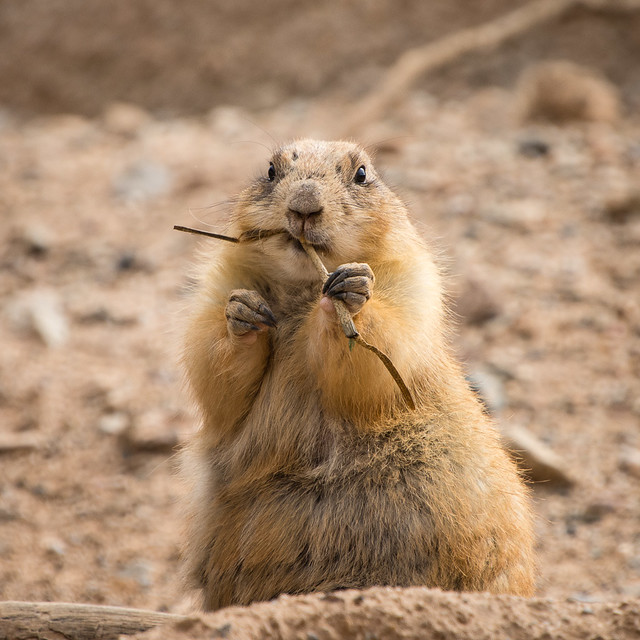
Prairie dog

Prairie dogs are ecological heroes, helping to conserve and manage grassland biodiversity

Reforestation project in the Canora area will act as an important green buffer and wildlife corridor

Nature Saskatchewan responds to social distancing with nature journals, bingo cards, and virtual tours

The Northeast Swale Watchers have resigned from the committee planning the Saskatoon Freeway: “Although we continue to believe that we have much to contribute to this discussion, it has become clear that our concerns are being ignored within this process”

From Information to Action
Understanding which birds are most likely to collide with buildings – migrants, insect-eaters, woodland species – we are better equipped to prevent it happening

10 suggestions for being an ally of Indigenous-led conservation

A growing number of PEI potato farmers are planting small plots of pollinator-friendly flowers and other plants in less productive parts of their fields

The future of Libraries of Things includes self-serve, tech-driven options with municipal support

Triodoos, an ethical banking group, has designed its new office building to be not only energy positive but also fully reconstructible

Andean condor

That’s Amazing!
Some deep-sea fish camouflage themselves by absorbing up to 99.956 percent of the light that hits them. Some even have ultra-black gut linings, likely to keep them from glowing like lanterns when they eat bioluminescent prey

Riding the air currents – the Andean Condor can fly for more than 5 hours without flapping its wings

EcoSask News is a weekly round-up of local news and events. Email us if you have items you would like us to include. 

You can follow EcoFriendly Sask by liking us on Facebook, following us on Twitter, or by email (top right corner). 

Download EcoFriendly Sask’s Nature Companion, a free nature app for Canada’s four western provinces


Tuesday, 21 January 2020

EcoSask News, January 21, 2020

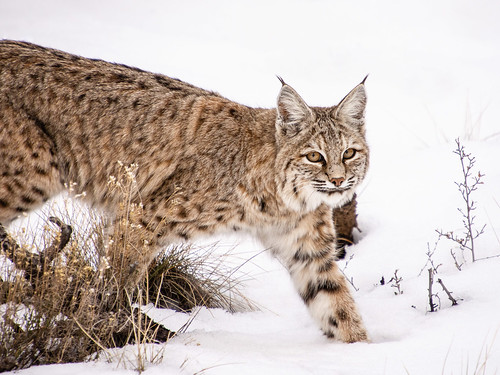
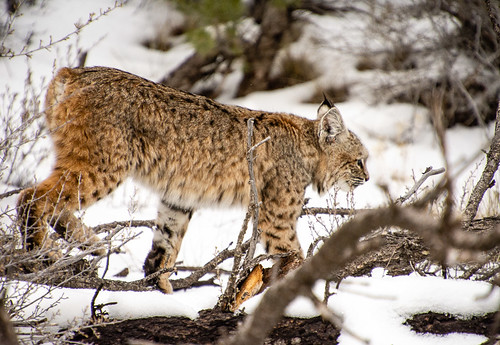
Bobcat (Lynx rufus)

Upcoming Events
Shoe Repair, Jan. 22 (Saskatoon) 
Find out how to make your shoes last longer at a winter shoe/boot maintenance and repair workshop from 6:30-8 pm, Jan. 22.

Fish Hatchery, Jan. 24 (Moose Jaw) 
There will be a presentation about the Moose Jaw Wildlife Federation’s mobile fish hatchery at the 6:30 pm, Jan. 24, meeting of the Moose Jaw Nature Society.

Sharp-tailed Grouse, Jan. 25 (Fort Qu’Appelle) 
Brandon Burda will discuss sharp-tailed grouse habitat selection and population trends at the 7 pm, Jan. 25, meeting of the Fort Qu’Appelle Nature Society at the Fort Qu’Appelle Train Station.

Richard St. Barbe Baker, Jan. 25 (Saskatoon) 
Paul Hanley and Richard White will introduce Richard St. Barbe Baker, founder of the international Men of the Trees organisation, from 7-9 pm, Jan. 25.

Bike Regina AGM, Jan. 28 (Regina) 
Bike Regina is holding its annual general meeting at 6:30 pm, Jan. 28.

Energy & Material Flows, Jan. 28 (Saskatoon) 
Darrin Qualman will discuss sustainability: energy & material flows in human & natural systems at the 7:30 pm, Jan. 28, Café Scientifique YXE.

Beavers & Natural Infrastructure, Jan. 28 (webinar)
Miistakis Institute and the Candian Wildlife Service will be presenting a webinar on beavers and other natural infrastructure solutions from 12-1:30 pm CST, Jan. 28. Register by Jan. 24.

Untitled

Looking Ahead
Repair Café, Feb. 1 (Gravelbourg) 
Gravelbourg Green Initiatives is hosting their second repair café from 9 am-noon, Feb. 1.

Art & Craft Supply Swap, Feb. 1 (Gravelbourg)
Swap and shop for art and craft supplies from 9 am-noon, Feb. 1, in Gravelbourg.

Winter by the Lake, Feb. 1 (Anglin Lake) 
Enjoy cross-country skiing and snowshoeing at Anglin Lake from 1-4 pm, Feb. 1.

Winter Power-up Workshops, Feb. 1 (Regina) 
Join the Regina Public Interest Research Group for issue sessions and skill-building workshops for social and environmental justice on Feb. 1.

Gone Wild for Wildlife, Feb. 1 (Saskatoon) 
Take the whole family to Gone Wild for Wildlife from 10 am-5 pm, Feb. 1, for nature activities, science experiments, lectures, and live wildlife.

A full list of upcoming events can be found on the EcoFriendly Sask Calendar 

Bobcat (Lynx rufus)

In the News
Regina’s EnviroCollective invites people under 30 to complete a short survey to keep the conversation going around renewable energy in Regina following last year’s youth community forum. Deadline is Jan. 30, 2020.

Canadian Institute for Climate Choices is a network of researchers who hope to produce rigorous and independent research, analysis and insight to bring clarity to the climate challenges and transformative policy choices ahead for Canada.

Contrary to popular belief, it’s very difficult to break down compostable plastics and they are only effective where the appropriate composting facilities are available.

“Coyotes test what decisions we make when we cross paths with those who are different” and are “a bellwether of our ability to live in community.”

Bobcats will live in cities, but they keep their distance from people, avoiding areas that are more than 20% developed.

Conservation policies based on the native-alien dichotomy could threaten biodiversity.

Success! After many years of legal and political battles, Jumbo Glacier will remain wild. Rather than a resort, the area will become an Indigenous Protected and Conserved Area and will provide a valuable wildlife corridor for grizzly bears travelling north-south between Canada and the United States.

Electric cars work great – even in extreme cold.

EcoSask News is a weekly round-up of local news and events. Email us if you have items you would like us to include. 

You can follow EcoFriendly Sask by liking us on Facebook, following us on Twitter, or by email (top right corner).

Tuesday, 30 July 2019

EcoSask News, July 30, 2019

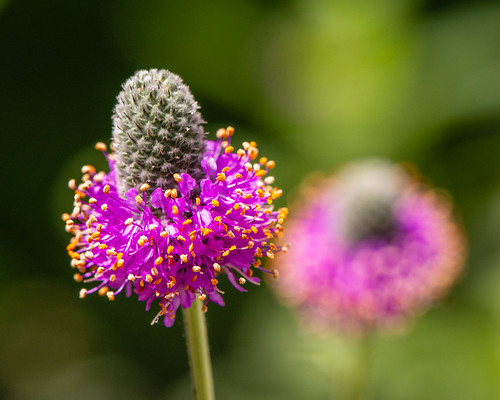
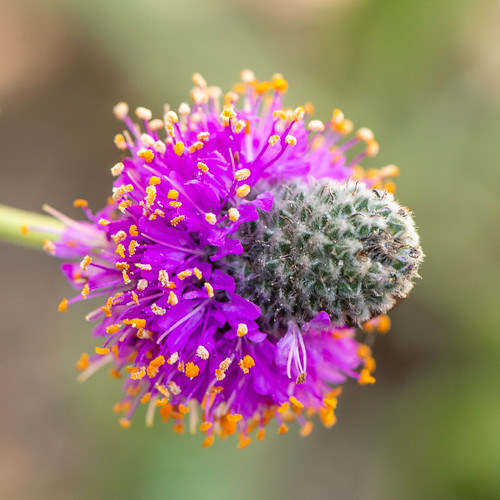
Purple prairie clover

Upcoming Events
Planet in Peril, Aug. 1, 8, 15 (Regina)
The Regina International Film Festival is showing 3 films by Edward Burtynsky on the human influence on the earth: Manufactured Landscapes at 7 pm, Aug. 1; Watermark at 7 pm, Aug. 8; and Anthropocene at 7 pm, Aug. 15. There will be a panel discussion following the film on Aug. 15.

Get Wild, Aug. 7 (Saskatoon)
Meet and learn about animals that have ended up at Living Sky Wildlife Rehabilitation from 2:30-3:30 pm, Aug. 7, at the Round Prairie Branch Library.

What’s in your Water, Aug 9 (Osler)
Join the South Saskatchewan Watershed Stewards from 2-3 pm, Aug. 9, at Osler Library to sample water and find out why it’s important to keep our watersheds healthy.

Looking Ahead
Bats then Beers, Aug. 16-17 (Last Mountain Lake)
Join the Saskatchewan chapter of The Wildlife Society at Last Mountain Lake Regional Park Aug. 16-17 as they go looking for bats and enjoy local beer.

Fish Id, Aug. 18 (Echo Lake)
Nature Regina is offering a fish identification workshop from 9 am-3:30 pm, Aug. 18.

Outdoor Adventures for Kids 
Nature Baby, Sept. 10-Oct. 29 (Saskatoon)
Wildernook Fresh Air Learning invites 6-18 month olds and their mobilizers to participate in Nature Baby from 11:15 am-12:45 pm, Tuesdays, Sept. 10 to Oct. 29.

Nature Grandparenting, Sept. 12-Oct. 17 (Saskatoon) 
Grandparents and their 3-5 year olds are invited to participate in Nature Grandparenting from 9:30-10:40 am, Thursdays, Sept. 12 to Oct. 17.

Early Fall Tiny Ones, Sept. 13-Oct. 25 (Saskatoon) 
Timbernook Saskatoon invites caregivers with 1½-4 year olds to enjoy outdoor adventures on Fridays from 9:30-11:30 am, Sept. 13-Oct. 25.

Early Fall Little Wild Ones, Sept. 13-Oct. 25 (Saskatoon) 
Timbernook Saskatoon invites 4-7 year olds who aren’t in school or are home schooling to participate in their forest program on Fridays from 1-4 pm, Sept. 13-Oct. 25.

Purple prairie clover

Saskatoon Nature Society
Golden Eagles 
Aug. 8, 8 am – Nature Walk at Schmeiser’s Acreage
Aug. 15, 8 am – Shorebirds
Retirees and partners who are interested in birds and the natural world are invited to participate.

Other Saskatoon Nature Society Field Trips 
Aug. 7, 6:45-8:15 pm – Prairie Wildflower & Tree Hike
Everyone is welcome. Check the Saskatoon Nature Society’s website for full details and updated information.

A full list of upcoming events can be found on the EcoFriendly Sask Calendar 

In the News
Meewasin Valley Authority is looking for volunteers to put up marker tags to make it easier for wildlife to see fences at Saskatoon’s Northeast Swale. Contact Renny Grilz if you’re interested.

Saskatoon residents are invited to complete a short survey on green infrastructure priorities. The deadline is Aug. 6.

The City of Regina plans to install brighter lighting in Victoria Park to help people feel safer. Are they also taking into consideration the effect of light pollution on plants, animals, and the night sky?

Thousands of people, minimal waste at Saskatoon’s Food Truck Wars.

Women are dominating the deconstruction industry: “Instead of focusing on trendy plastic straw bans, they are recycling whole houses.”

“ ‘Conserving the diversity in our soils may be the most effective health intervention we can ever make.’ . . . by getting your hands dirty planting trees or building soil erosion control structures — you are not only conserving biodiversity, you are also inoculating yourself with microbes that you yourself may need.”

Ikea’s new store in Greenwich, UK, combines solar, geothermal, orchards, rainwater harvesting, and much more.

Could large-scale biogas systems be the next big thing in green energy?

These photographs of urban trees are heartbreaking, “but in almost every photo, there is hope in the sense that the trees and topiary are still emerging through the cracks, taking back the land, or not necessarily playing by man’s rules due to their inherent qualities of being wild.”

EcoSask News is a weekly round-up of local news and events. Email us if you have items you would like us to include. 

You can follow EcoFriendly Sask by liking us on Facebook, following us on Twitter, or by email (top right corner).

Thursday, 11 October 2018

See The World Through My Eyes

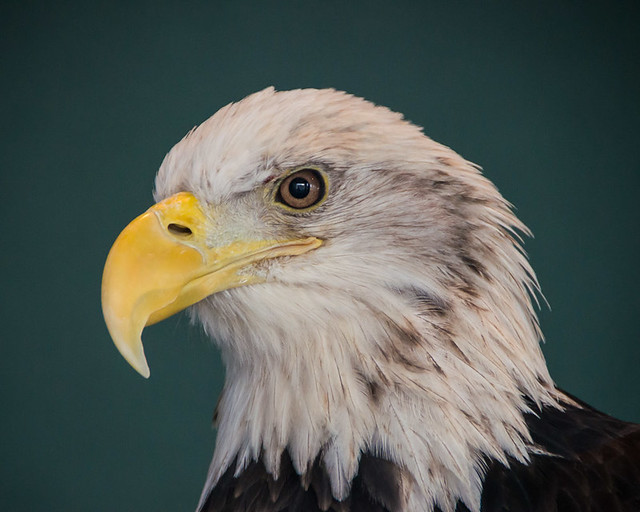
Bald eagle

Spiders with 8 eyes, eagles that can focus on two objects simultaneously – no two animals see the same thing. Here are just a few examples.

Bald Eagles
Talk about eyes in the back of your head! Eagles can focus on objects in front and beside them at the same time thanks to having two centres of focus. Their eyes are four times as sharp as human eyes. From a fixed position at 1,000 feet above the ground, they can spot prey in an area just under 8 km squared. An inner eyelid, called a nictitating membrane, slides across their eye every few seconds to wipe away dust or dirt.

Tawny Owl

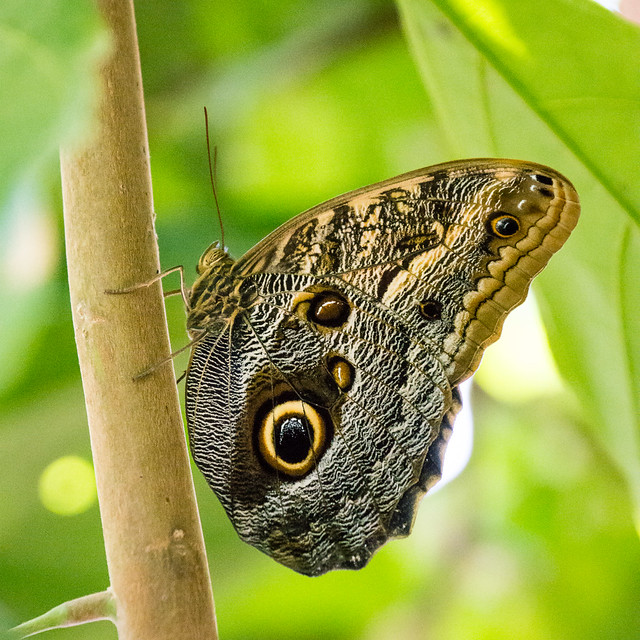
Butterflies & Moths
Some butterflies and moths have colourful patches on their wings that resemble eyes. Scientists speculate that they are used to frighten or distract potential predators. Owl butterfly have a bad reputation for getting drunk on fermented fruit.

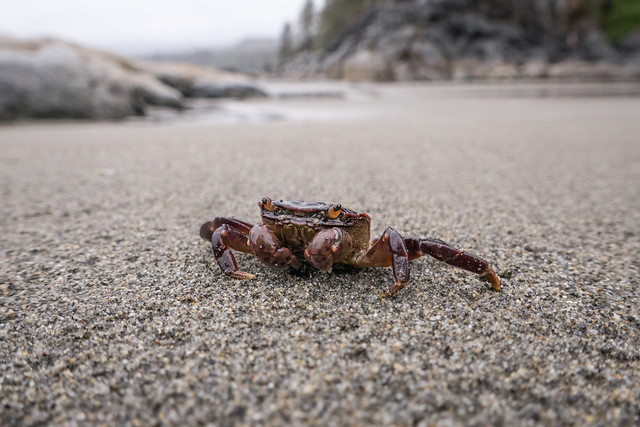
crab

Crabs
Fiddler crabs have almost-perfect all-round vision but, because their eyes don’t move, they use different parts of their eyes in different ways. Their sharpest vision is immediately in front of them and is used to identify and communicate with potential mates. Their overhead vision is limited to perceiving light and dark but is more than adequate for recognizing a seagull swooping down from the sky.

damselfly

Damselflies & Dragonflies
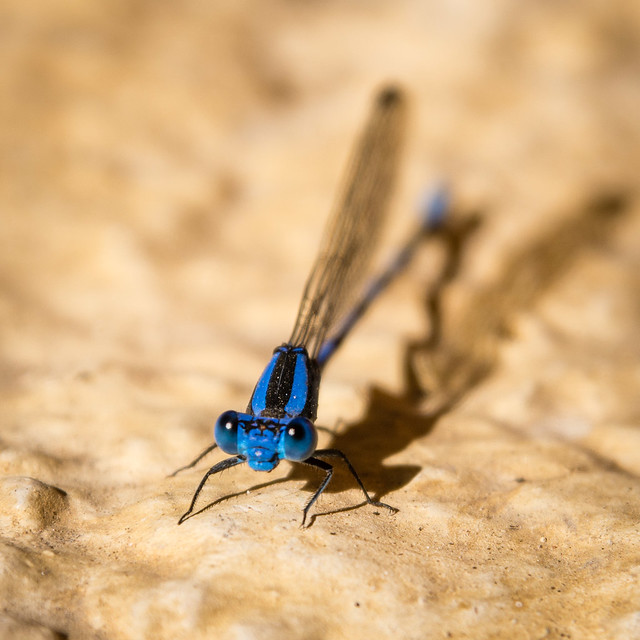
Huge eyes take up most of the space on dragonflies’ and damselflies’ heads. By piecing together images from their 20-30,000 individual lenses, they can see what’s happening all around them, essential for locating and capturing prey while hovering in mid-air. They also have 3 simple eyes on their forehead that can detect light intensity.

fish

Fish
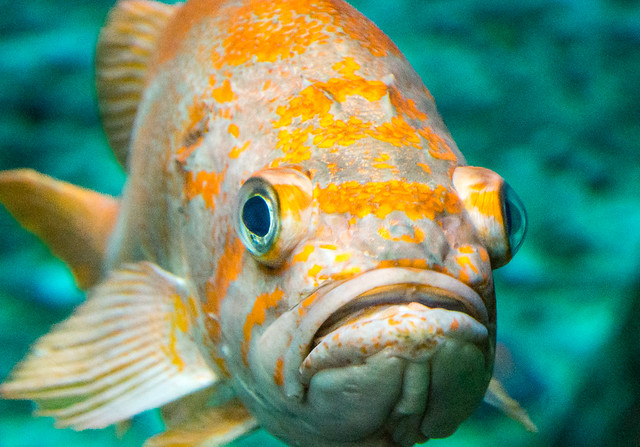
Fish can’t close their eyes as they don’t have eyelids. Some have transparent nictitating membranes they can pull down to protect their eyes, while others have light-activated pigments in their eyes that turn darker when exposed to a bright light.

Bull frog

Frogs & Toads
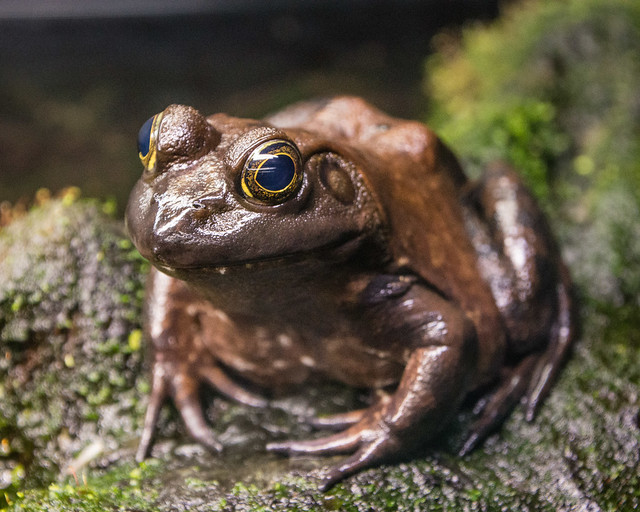
Now this is amazing! Have you noticed that frogs and toads shut their eyes when eating? Their eyes actually move backwards, helping the tongue to push food down their throat.

Barred owl (?)

Owls
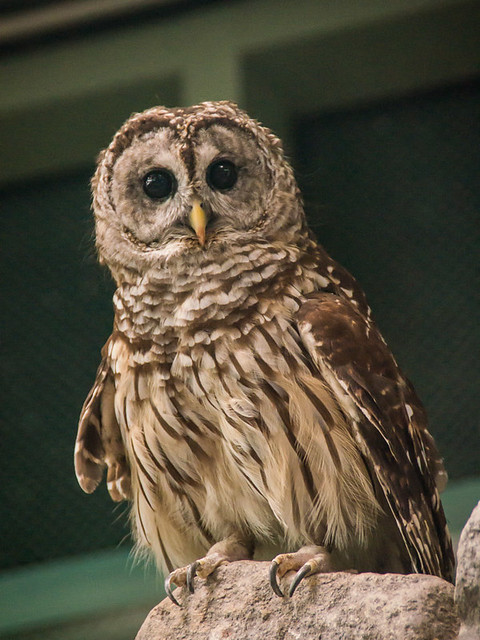
Owls’ eyes are shaped like tubes rather than spheres and are fixed in place, but they can turn their necks up to 135 degrees in either direction. A large retina and an abundance of rods ensure that owls can take advantage of whatever light is available at night. The rod cells are connected differently than human rod cells so they’re able to pick up edges, movement, and silhouettes in dim light.

pronghorn

Pronghorn
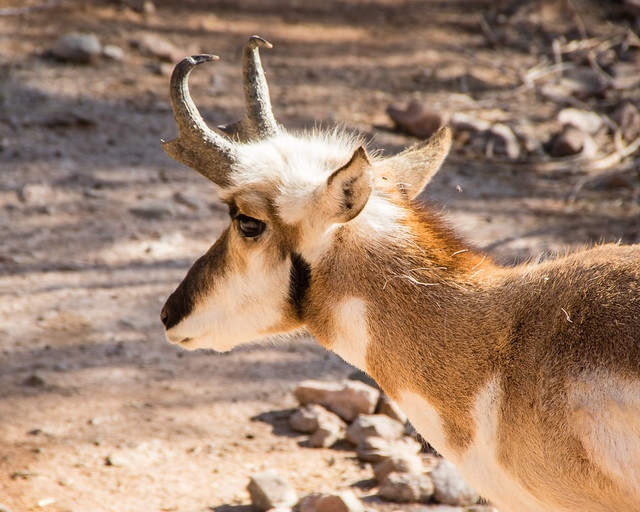
Pronghorn have large eyes (36 mm in diameter) near the back of their head. They can spot movement up to 6.5 km away and can view objects within a 300-degree arc without moving their head or eyes.

Fishing spider

Spiders
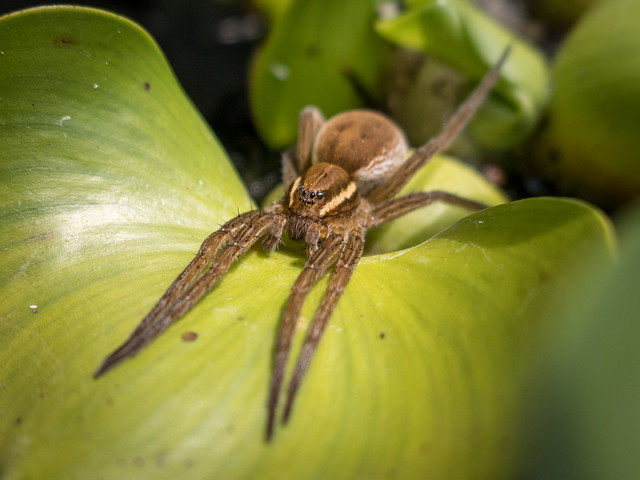
Most spiders have 8 eyes, but they’re not always arranged in the same way. For example, fishing spiders have 2 rows of 4 eyes, while wolf spiders have 3 rows of eyes (4-2-2). “Daylight hunting spiders use their two pairs of ‘side’ eyes to detect the motion of their prey. The spider then uses the two most central eyes to focus on their prey. The pair of eyes next to these are used for depth perception. When the target is close enough, these eyes let the spider know when to strike.”

Tuesday, 22 September 2015

EcoSask News, September 22, 2015

berries

Upcoming Events
Parrot Rescue, Oct. 4
Treena Cheveldayoff will introduce some of the parrots she has rescued and discuss parrot species, lifespans, and diets at Wild Birds Unlimited, 1-2:30 pm, Oct. 4.

Falcon Hunt, Oct. 4
Observe one of Dr. Lynn Oliphant’s falcons as it catches its prey. Meet at Wild Birds Unlimited at 4 pm, Oct. 4.

SK Energy Management Task Force, Oct. 7
The Saskatchewan Energy Management Task Force hosts monthly breakfast meetings for professionals with an interest in the effective use of energy and its related aspects. The meetings start at 7 am at the Confederation Inn. The speaker on Oct. 7 is Kent Rathwell, Sun Country Highway.

International Walk to School Day, Oct. 7
International Walk to School Day is a global event celebrating active transportation. If you’re worried about safety, you can participate by organizing a walking school bus, a group of children walking to school with one or more adults.

Operate Your Building More Efficiently, Oct. 9 (Estevan), Nov. 20 (Saskatoon)
Would you like your building to be more comfortable and have lower utility bills? Non-profit organizations and small businesses are invited to attend a one-day Building Operator Training seminar in Estevan on Oct. 9 and in Saskatoon on Nov. 20. You’ll learn how to efficiently operate your lighting, electrical equipment, heating, ventilation and cooling, and reduce your water use. Cost is only $30/person thanks to sponsorship by Affinity Credit Union.

Rob Dumont Awards Dinner, Oct. 14
The Rob Dumont Awards Dinner on Oct. 14 will honour today's leaders in energy management. Proceeds from the dinner will go to the Rob Dumont Foundation dedicated to supporting individuals and organizations related to energy management. Dave White will speak on innovation, creativity, and values. Tickets are available on Picatic.

Sustainability Champions Training
Current and recently graduated university students are invited to join IMPACT! Sustainability Champions Training. The training includes a 3-day workshop on sustainability leadership and social entrepreneurship, 4 months of mentorship, and a networking evening with local social entrepreneurs. Applications are due Oct. 18.

Untitled

Field Trips
Golden Eagles
Oct. 1, 9 am – Geese & Other Migrants
Oct. 8, 9 am – Whooping Cranes
Oct. 15, 9 am – Pike Lake Area
Retirees and partners who are interested in birds and the natural world are invited to participate in Golden Eagle field trips.

Other Saskatoon Nature Society Field Trips 
Oct. 2, 7-10 pm – Saw-Whet Owl Banding
Oct. 10, 8 am-5 pm – Whooping Crane Trip
Oct. 12, 9:30-11:30 am – Woodlawn Cemetery & Weir
Check the Saskatoon Nature Society’s website for full details (e.g. some trips require rubber boots, others will be cancelled if the weather is bad).

A full list of upcoming events can be found on the EcoFriendly Sask Calendar 

News
Many of the new "exotic" pollutants can't be removed through current water treatment methods

Endangered and threatened marine fish species in Canada are routinely refused protection by the federal government

EcoSask News is a weekly round-up of local news and events. Email us if you have items you would like us to include. 

You can follow EcoFriendly Sask by liking us on Facebook, following us on Twitter, or by email (top right corner).

Thursday, 5 March 2015

South Saskatchewan River Watershed Stewards

Renny Grilz, South Saskatchewan River Watershed Stewards

The South Saskatchewan River flows east into Saskatchewan and Lake Diefenbaker, stretching for 716 kilometres before converging with the North Saskatchewan River east of Prince Albert. Over half of Saskatchewan’s population relies on the South Saskatchewan for drinking water and a large part of our farming community uses river water to irrigate their fields.

In 2007, the provincial government established a Source Water Protection Plan for the South Saskatchewan River watershed. Local advisory boards were established in three areas of the watershed to oversee implementation of the plan.

The South Saskatchewan River Watershed Stewards Inc. is a community-based, non-profit organization. Their goal is to ensure safe, sustainable water supplies for the economic, social, and environmental wellbeing of the watershed and its users. The board members represent the cities, towns, villages, rural municipalities, and special interest groups of the region, including the Meewasin Valley Authority, Beardy’s and Okemasis First Nation, and the Pike Lake Cottage and Watershed Association.

The organization is part of the Saskatchewan Association of Watersheds, an umbrella group for the 11 watershed associations in the province.

Watershed Protection 
The overall objective of the South Saskatchewan River Watershed Stewards is to protect the quality and quantity of surface and ground water within the watershed. As Renny Grilz, Watershed Coordinator, explains, this is an ambitious mandate that encompasses many different issues. With only limited human and financial resources, their goal is to collaborate with other organizations in order to address issues such as invasive species, flooding, and drainage.

“A big part of my job is to make those partnerships and connections,” Renny explains. “As a small organization, we can’t do it all ourselves.” Renny is well suited for this position as he has previously worked with a number of other environmental organizations, including Ducks Unlimited Canada, Nature Conservancy of Canada, and Environment Canada.

SSRWSI-MLA reception at the SK Legislature: Vice-Chair Rob Oldhaver, Coordinator Renny Grilz, Chair Ben Buhler

Aquatic Invasive Species
Aquatic invasive species, such as zebra and quagga mussels, have the potential to do a tremendous amount of damage to the watershed. “The mussels could have a major impact on the City of Saskatoon’s water intake,” Renny says. “They’re really small mussels, but they coat the intake pipe until its full.” They could also damage SaskPower’s equipment at Gardiner Dam, coat and compete for resources with the province’s native clams, and potentially change the water chemistry.

Zebra mussels were found in Manitoba in 2013, so Saskatchewan is at very high risk. “The costs to taxpayers would be horrendous,” Renny says. “Alberta estimates that it will cost taxpayers $75 million per year to manage their infrastructure if zebra mussels become established. The numbers haven’t been calculated in Saskatchewan but will be anywhere from $15-30 million a year.”

The Watershed Stewards will be working with the Ministry of the Environment to offer awareness and monitoring programs and presentations in 2015. Posters, pamphlets and signage for boat launches are being developed. Substrate samples from Lake Diefenbaker, Blackstrap, Pike Lake, and Saskatoon will be collected on a monthly basis to check for the presence of adult zebra mussels.

Contact SSRWSI if you are interested in helping them with their work to prevent the spread of zebra and quagga mussels.

Flooding 
Communities north of Saskatoon have been dealing with severe flooding and water contamination issues for the past few years. Beardy’s and Okemasis First Nation has had to shut down 50 wells and cisterns due to contamination. The Watershed Stewards are working with the First Nation and the Rural Municipality of Duck Lake to develop a community-based source water protection plan. 

Drainage 
“Agricultural drainage is a balancing act,” Renny says. “We’re only one rain or snowfall away from a flood or a drought.” The Saskatchewan Water Security Agency recently conducted an agricultural drainage survey and this will be a key topic of discussion at the 2015 Saskatchewan Association of Watersheds Conference.

Irrigation 
One of the primary reasons for the creation of Lake Diefenbaker was to develop irrigation capacity in south-central Saskatchewan. There is an increasing demand for irrigation to meet global food needs. However, as the demands for water from Lake Diefenbaker and the South Saskatchewan River increase, water allocation strategies may be required.

Technology is now available that would allow farmers to minimize water usage by programming irrigation equipment to manage local conditions – individual sprinklers can be turned off over roads and wet spots, while increased volume can be provided on drier hilltops. “The cost is still prohibitive,” Renny says, “but it could revolutionize irrigation. California farmers are adopting it because water is at a premium. It won’t be long before it reaches here.”

variable rate irrigation system at Outlook

Fisheries 
The Watershed Stewards are planning to ramp up their fisheries work. They’ve already done an initial assessment of some creeks that flow into the South Saskatchewan. They’d like to expand this work to look at threats and to start offering programs to mitigate risks. For example, they could work with a municipality to lower a culvert so that fish can get through.

Lake Diefenbaker 
We’re fortunate that the water quality in Saskatoon is really good considering the population upstream. “Lake Diefenbaker acts as a large settling pond,” Renny explains. “The water quality is greatly improved when it leaves the lake.” This does, however, lead to accumulation of organic contaminants behind the dam and slows down water flow.

There have been concerns about the lake level going up and down. When the level drops, it causes erosion. When it goes up, there is flooding and fences are washed out. There are also recreational concerns, and changes in the level can alter the amount of water available for irrigation. The Water Security Agency has been working on a management plan, but it is not yet complete.

Pike Lake community-based watershed planning meeting

Pike Lake 
The South Saskatchewan Watershed Stewards are working with the Pike Lake Cottage and Watershed Association and other stakeholders in the area, including Pike Lake Provincial Park, the Rural Municipality of Asquith, local landowners and farmers, to develop their own community-based watershed management plan.

Public Awareness 
An ongoing task for the Watershed Stewards is to create public awareness of the importance of watersheds for healthy communities and livelihoods. By being proactive, they can reduce risks of contamination and fix past issues.

The organization is currently working with the Native Plant Society of Saskatchewan to develop a Master Naturalist Program. Similar programs exist in other areas (Alberta, Texas) and trained volunteers could play an important role in monitoring storm water (not currently monitored), river water, and zebra mussels.

Thursday, 28 November 2013

Pine Cree Regional Park


In the Cypress Hills, just 13 kilometres from Eastend, lies Pine Cree Regional Park. It’s a small, natural park featuring “old time quiet starry nights, watchable wildlife, wildflowers galore, fishing, and hiking.” Swift Current Creek runs through the site, providing clear, cold running water all year long.

The park was initially developed by Everett Baker, a Saskatchewan naturalist, historian, and photographer. In 1970, Pine Cree became a regional park, commemorating the memory of Everett Baker and John Macoun, a member of the Canadian Geological Survey who camped in the area in the 1880s.

There are three self-guided trails through the park that can be booked through the park officer. One trail takes you up to the highest point in the park where you will discover teepee rings, while another leads you up above the Hermit’s Cave. All three trails are described in Robin and Arlene Karpan’s book, Saskatchewan’s Best Hikes and Nature Walks.


EcoFriendly Action Grant
In June, the park applied for an EcoFriendly Action Grant to help clean up a portion of the creek. A 1980s fish enhancement project had used long spikes and stems of rebar to attach treated timber and long planks to the banks of the creek. Over time, the timber and planks had worked loose, causing jamming and bank destruction and exposing pointed segments of rebar.

Thanks to a $500 grant from EcoFriendly Sask, the park hired Darcy French to remove the timber. Joan Hodgins, the Parks Officer, says, “The work was arduous manual labour, requiring the use of a chain saw, bow saw, crowbars, sledge hammers, axes and hours of work in the cold waters of the spring-fed creek. The portion that was the focus this year was at the north end of the campground, where the fishing is popular, and had no access to the road, so everything had to be carried out to the truck to be disposed.”

Darcy spent 40 hours on the project and was helped on his last day by Riley, a volunteer, and Ashley, a staff person.

Joan goes on to say, “Thank you so much for allotting us the grant money. The Pine Cree Regional Park Authority truly appreciated it and put it to very good use. This project would not have been done without your contribution. The campers and the wildlife have a safer environment.”


Swift Current Creek
Brittney Hoemsen, TRoutreach Saskatchewan’s Project Coordinator, is very familiar with the park. She says, “It's an amazing park. We started sampling it only because it was so pretty there but what we found kept us coming back! It's a small creek with cold (around 4 degrees average all year), clear running water, which is fairly rare in Saskatchewan. It therefore supports many insects that aren't found anywhere else! We found a new species of midge (Odontomesa fulva) that isn't found anywhere else in Saskatchewan. We also found a caddisfly family, Neophylax splendens, which is new to Saskatchewan.

"These organisms are very sensitive to human pollution so they can only be found in places with excellent water quality and healthy stream banks, such as Pine Cree Creek. It's important that we maintain the pristine areas when we can so I really appreciate you supporting this project!!”

Additional information:
Pine Cree Regional Park website
TRoutreach Saskatchewan’s Facebook page
Friends of Pine Cree Park Facebook page
Everett Baker’s Saskatchewan: Portraits of an Era by Bill Waiser (a compilation of Baker’s photographs of Saskatchewan in the mid-twentieth century)
Eastend Hiking & Driving Tours (Auto Tour #2 takes you through the park)

Photo Credits: First photo provided by TRoutreach Saskatchewan; other photos provided by Pine Cree Regional Park

Tuesday, 14 August 2012

EcoSask News, August 14, 2012

We're on the lookout for sage grouse and salamanders, youth writers and leaders,  
budding entomologists and provincial water strategies


Wildlife
Entomological Extravaganza, August 18
Budding entomologists are invited to join TRoutreach Saskatchewan and the Entomological Society of Saskatchewan for a day in the sun and stream collecting insects. The Entomological Extravaganza is scheduled for August 18 at Pine Cree Creek in the Cypress Hills.

Vote Now, Vote Often
Show your support for Saskatchewan’s endangered species by voting (up to once a day) for Nature Saskatchewan who are participating in Jamieson’s Call for the Wild competition. Jamieson will be giving out $100,000 to five competing organizations, based on the votes they receive. The funds will help support Nature Saskatchewan’s Stewards of Saskatchewan programs.

Tiger Salamanders
Andrew McKinlay recently spotted a couple of tiger salamanders on the Meewasin Trail. Tiger salamanders are the largest land-dwelling salamanders on earth (up to 14"/35 cm in length). They live in deep burrows up to 2 ft/60 cm below the surface. They emerge at night to eat worms, insects, frogs, and even other salamanders and can live on average 10-16 years in the wild.

Sage Grouse
Fifteen percent of Sage Grouse die because they get caught in wire fences. Plastic clips hooked on fence wires are a simple, effective solution.

Obscure and Unloved 
The federal government has refused to list three species as endangered. Is this a reasonable decision, or is it the thin edge of the wedge? The Ottawa Citizen has an excellent review of the topic. For more information, you can follow Laura the Dragonfly, the Sierra Club of Canada’s spokesperson, on Facebook or Twitter.

National Urban Park
CPAWS is urging Canadians to respond to Parks Canada’s on-line questionnaire about Rouge National Urban Park in Toronto. CPAWS believes that the park should have a strong legal mandate prioritizing conservation to avoid the risk of being overrun with visitors and "loved to death."

Water
Developing a Provincial Water Strategy 
The Government of Saskatchewan is asking for public feedback on a 25-year provincial water strategy. Last year’s discussions with key stakeholders indicated that water is a key provincial resource that is extremely volatile due to the prairie climate and recommended that the government establish provincial and sectoral water management goals. The government proposes establishing a new corporation that would be responsible for consolidating government's core water management expertise and reduce current overlaps.

Drought in the Midwest 
William G. Moseley argues that the drought in the Midwest could be beneficial if it inspires greater crop diversification and decentralization.

The Island President
Did you get a chance to see the film about the Maldives, which are flooding due to rising ocean levels? If not, here’s a 45 minute video discussion with Bill McKibben (350.org) and Jon Shenk (the filmmaker).


Youth
Next Up Leadership Program
Applications are now being accepted for Next Up, a leadership program for young people committed to social and environmental justice. The deadline for Next Up Saskatchewan is September 14.

Young Writers Awards for Excellence
Youth ages 15 and under and 16 to 21 are encouraged to apply for the Paul Beingessner Award for Excellence in Writing from the National Farmers Union. The essay topic is “Cooperatives: An Exercise in Democracy,” and there is a $500 prize in both age categories.

EcoSask News is a weekly round-up of local news and events. Email us if you have items you would like us to include. A complete listing of all upcoming events can be found on our Calendar.

You can follow EcoFriendly Sask by liking us on Facebook, following us on Twitter, or by email (top right corner).

Friday, 10 August 2012

TRoutreach Saskatchewan

TRoutreach Saskatchewan is a small, enthusiastic group of Biology graduates from the University of Saskatchewan. They are studying the aquatic insects that filter the water in Saskatchewan streams and turn decaying plant and animal material into food. The insects are also an important food source for trout.

Each insect species reacts to pollutants in a characteristic manner, responding quickly to any stressor they encounter. Because they play a key role in the food chain and are relatively sedentary, the impact of pollution on these insects is a valuable clue to the overall health of the aquatic ecosystem.

Fish & Insects
TRoutreach has been involved in several different research projects this summer. As part of an ongoing project, they are studying the trout in Pine Cree Creek in the Cypress Hills.

They visit the site monthly to collect aquatic insects in order to recreate the diet of the brook trout using stable isotope analysis. This is cutting-edge technology that will provide a much more accurate assessment of what the fish eat than would be provided by analysing the gut contents of fish.

The group has also immersed baskets of local pebbles in three different streams in the province. They will go back at the end of the summer to collect the baskets and count the insects that colonized the area. By immersing the baskets at different levels of sedimentation, they will be able to judge tolerance to stressors, such as sedimentation.

TRoutreach members are also collecting beetles at Gardiner Dam using pitfall traps. These are yogurt containers that have been set into the ground. When the beetle walks over the trap, they fall in and are captured. The group’s goal is to develop an effective method of trapping beetles and to determine what beetles can be found at Gardiner Dam.

Outreach
Outreach is an integral part of all their work as TRoutreach members want to share their enthusiasm and love of the environment with others. They work with school groups, helping the students to “see” all the insects in the water.

Budding entomologists are invited to join TRoutreach and the Entomological Society of Saskatchewan for a day in the sun and stream collecting insects. The Entomological Extravaganza is scheduled for August 18 at Pine Cree Creek in the Cypress Hills. Everyone is invited to attend.

TRoutreach Saskatchewan receives administrative assistance from the Saskatchewan Wildlife Federation.

You can follow the group’s progress on Facebook. Donations would be appreciated to finance the stable isotope analysis.

(TRoutreach Saskatchewan has successfully applied for two EcoFriendly Action Grants.)