Showing posts with label Amphibians. Show all posts

Tuesday, 14 September 2021

EcoSask News, September 14, 2021

wood frog

Upcoming Events 
The Saskatoon Nature Society is hosting an online presentation on amphibians at 7:30 pm, Sept. 16. 

Library of Things, Saskatoon, will be open for pick-ups by reservation from the back door in the alley from 1-4 pm, Sept. 18. 

Nature Regina is hosting a presentation on the Treaty Land Sharing Network at 7:30 pm, Sept. 20, at the Royal Saskatchewan Museum. 

The Saskatoon Nature Society is inviting the public to attend a Sandhill Crane viewing from 6-8 pm, Sept. 20. 

The Saskatchewan Environmental Society and the Saskatoon Public Library are offering an online presentation on Electricity in Saskatchewan: Current Status, Future Prospects from 7-8:30 pm, Sept. 21. 

The Johnson-Shoyama Graduate School of Public Policy is hosting a video conference on nuclear development, communicating risk, and public engagement at noon, Sept. 23. 

There will be a global climate strike at noon, Sept. 24, in Saskatoon. 
 
Full event details can be found on the EcoFriendly Sask Calendar

Local News 
William Hale has opened a used electric vehicle dealership in Saskatoon. William says he’s driven an electric vehicle (EV), winter and summer, for 3 years and loves it. “The electrification of transportation is one of the principal pathways to a low carbon economy and I want to help with this transition in Saskatchewan,” he explains. The dealership offers a lower-priced entry into the EV market and an opportunity to ask questions and test drive the vehicles. They also sell and install EV chargers for home use. 

Green Shift Automotive in Regina sells a range of electric vehicles from bikes, scooters, and skateboards to hybrid and electric cars. 

Alberta Lake Management Society is offering a fall webinar series with applicability across Canada. 

Transportation 
Exposure to traffic noise is associated with a range of health problems, including dementia, heart disease, diabetes, and obesity. [The Guardian

The six problems aviation must fix to hit net zero: 1. fuel; 2. non-CO2 impacts, such as nitrogen oxides and contrail clouds; 3. frequent flyers; 4. policy development; 5. the new middle class; and 6. supersonic planes. [The Guardian]

Mormon cricket

Wildlife 
Wildlife rescuers are the first to provide medical care for injured or sick animals and could provide an early-warning system for illnesses that also affect humans. [The Revelator

“Mountain and boreal caribou are on a long-term slide to extinction; not because of what wolves and other predators are doing but because of what humans have already done.” [Raincoast Conservation Foundation

“Rebugging is looking at the ways, small and large, to nurture complex communities of these tiny, vital players in almost all the natural and not-so-natural places on earth. It means conserving them where they are managing to hang on, and restoring them where they are needed as part of a rewilding movement. And it means putting bugs back into our everyday lives, our homes and where we play and work.” [The Revelator, an excerpt from Rebugging the Planet: The Remarkable Things that Insects (and Other Invertebrates) Do – And Why We Need to Love Them More by Vicki Hird) 

When they’re not looking for a mate, some female hummingbirds are adopting the same brightly coloured ornamentation as males as it “helps them avoid aggressive male behaviors during feeding, such as pecking and body slamming.” [Science Daily

Energy 
“Air conditioning is the most obvious immediate response to the dangerous warming of the planet. It’s also making it worse. … People are going to keep buying air conditioners … so we need to offer them better, safer, cleaner devices … We’re doing a disservice to our citizenry when we let them buy something that is so expensive to operate, and so polluting that cooling is actually adding to the warming of the planet.” [The Guardian

Coal-fired plants made up 40% of global energy output in 2010. Here’s a breakdown of consumption on a country- by-country basis as well as a look at steps that could be taken to end coal use. [Climate Solutions

Despite what oil and gas companies would have you believe, blue hydrogen isn’t clean or economically viable. [DeSmog


Did you know?
Wood Frog hibernate under logs or leaf litter and can tolerate below-zero temperatures by increasing the amount of glucose in their blood, which lowers the freezing point and stops ice crystals from forming. [Nature Companion

EcoFriendly Sask supports Saskatchewan environmental initiatives through an online publication, an events calendar, small grants, and the Nature Companion website/app. You can follow EcoFriendly Sask by liking us on Facebook, following us on Twitter, or subscribing by email (top right corner).


Tuesday, 19 January 2021

EcoSask News, January 19, 2021

Untitled

Upcoming Events 
Sustainable YXE, Jan. 21 (online) 
Saskatoon Public Library is hosting an online discussion for teens about making our community more sustainable from 6-7 pm, Jan. 21. 

Vacationing in the Tropics, Jan. 22 (online) 
Nicholas Bayly will discuss the ecology and conservation of Canadian-breeding migratory birds in Colombia in the WildEcol Seminar Series at 3:30 pm, Jan. 22. 

Wildlife Rehab Orientation, Jan. 23 (online) 
WRSOS is holding a virtual wildlife rehabilitation orientation at 1 pm, Jan. 23. 

Eco-Scavenger Hunt, Jan. 23 & 30 (Saskatoon) 
Meewasin Valley Authority is hosting self-directed eco-scavenger hunts to help track wildlife at Beaver Creek Conservation Area on Jan. 23 & 30; Feb. 13, 18, 19, & 27; and Mar. 13 & 27. 

Where & How People Live, Jan. 26 (online) 
There will be an online discussion of how climate change is contributing to human migration as well as an update on local climate action at 7 pm, Jan. 26, as part of the Sustainability Speaker Series organized by the Saskatoon Public Library and the Saskatchewan Environmental Society. 

A Landscape Ethic, Jan. 28 (online) 
Dr. Hamilton Greenwood will share his photographic adventures and reflections on the beauty of Western Canada online at 7 pm, Jan. 28 (John M. Cuelenaere Library, Prince Albert). 

At Risk: Mormon Metalmark Butterflies, Jan. 28 (online) 
Shelley Pruss, Parks Canada, will discuss Mormon Metalmark butterflies, an uncommon species found in the Prairie Badlands at noon, Jan. 28, as part of the Native Prairie Speaker Series. 

Winter Readiness, Jan. 28 (online) 
Regina Public Library and Parks Canada are offering a program on animals that are masters at adapting to winter conditions at 7 pm, Jan. 28. 

Looking Ahead
Speed Networking, Jan. 29 (online) 
The Canadian Environmental Network is hosting a speed networking hour at 3 pm, Jan. 29, to help environmental organization leaders meet and find ways to collaborate

Repair Café, Jan. 30 (online) 
The Saskatchewan Waste Reduction Council is hosting a virtual repair café 11 am-2 pm, Jan. 30. 

Winter Walk, Jan. 30 (Regina) 
The public is invited to join Nature Regina for a bird watching walk and to find out what happens under the snow and ice in winter at 10, 10:30, or 11 am, Jan. 30. 

Saskatoon Nature Society Field Trips 
Jan. 30, 11 am-7 pm – Great Gray Owl Excursion 
Feb. 6, 2-3:30 pm – Forestry Farm Bird Walk 
Field trips are currently for members only, so sign up now. Advance registration is required. 

A full list of upcoming events (online and in person) can be found on the EcoFriendly Sask Calendar 

Local News 
The Athabasca Nuhenéné community has set up a Facebook page to share their connection to their land and culture and the need to preserve it

Agricultural drainage standards need to be in place and enforced to protect the environment and people. 

New! Responding to Climate Change: A Primer for K-12 Education, Sustainability and Education Policy Network 

The University of Saskatchewan and FCL continue to support research into cleaning up and managing contaminated sites

A growing chorus of experts says carbon capture isn’t all that effective and could even add to greenhouse gas emissions. 

How will Saskatchewan’s water supply be affected by Alberta's decisions regarding coal mining? Although a few coal leases were cancelled (January 18, 2021), most remain and would affect the water source for the Canadian Prairies.
 
Untitled

From Information to Action 
Hydrogen is a lifeline for the oil and gas industry and a distraction from proven technologies – wind, solar, battery storage. 

The textile industry creates 10% of global CO2 emissions. “With production projected to increase 81% by 2030, we are sleepwalking into an environmental disaster.” 

“By 2040, forests will take up only half as much carbon dioxide from the atmosphere as they do now, if global temperatures keep rising at the present pace.” 

Good News 
Two 17-year-olds are on a mission – to rewild Britain by restoring reptile and amphibian species that are either virtually extinct or have been extinct for centuries. 

The Harmony Project offers teaching resources to develop learning based on a deep understanding of, and connection to, the natural world

Thank you for reading EcoSask News. If you enjoyed it, please share it with someone – or many someones! 

You can follow EcoFriendly Sask by liking us on Facebook, following us on Twitter, or by email (top right corner). 


Did you know? Great Gray Owl have very good hearing and can detect prey under 2 ft of snow thanks to the facial disc feathers that channel sound to the ears (Nature Companion, a free nature app for Western Canada)

Sunday, 12 July 2020

Introducing Nature Companion: An Entry-Level Nature App for Canada's Four Western Provinces


“Be an explorer of your own streams and oceans . . . . It’s not what you look at that matters, it’s what you see.” Henry David Thoreau 

You’re walking in a park or by a river and you spot a small frog, an orange butterfly, a bird pecking on a tree, or a shrub with red berries. What is it? Is the animal you spotted from a distance a coyote or a cougar? What is the tall yellow flower growing beside the road?

Four years ago, Andrew McKinlay was hiking in Big Bend National Park in Texas and was frustrated. He was seeing all sorts of interesting plants, insects, trees, and other wildlife but was struggling to identify them. “What I need is one app that lists the most common plants, trees, animals, insects, reptiles, and birds that I’ll find in a particular area,” he said. “There are lots of specific bird, flower, or insect guides, but nothing together in one convenient package that I can download on my phone for easy access.”

 And so began a new EcoFriendly Sask project. Developed for curious observers, people who are interested in nature, the Nature Companion website/app will help you identify plants and animals in your community or as you travel in Canada’s four western provinces. In just one app, you’ll find basic information about over 300 common plants, trees, birds, animals, insects, reptiles, and amphibians.


Scroll through the colourful photographs and short descriptions to find out more about nature in your community and enjoy the unexpected details in the Did you know? section at the end of each description.

Nature Companion is free (no ads or sign up). It can be accessed either on or off line and can be installed on your phone or tablet.

Whether you’re travelling in another province, an expert on birds but not on reptiles, young or old, or a newcomer to Canada, we hope you will find Nature Companion a useful guide as you explore the natural world.

If you know someone - or many someones - who might be interested in Nature Companion, please share it with them.

A huge vote of thanks to our early reviewers who provided so many helpful suggestions that we've done our best to incorporate into Nature Companion. Please email us your feedback - we'd love to hear from you.

PS Check the Help (the ? at the top right) for assistance in installing the app. The initial download may be slow, but the app should be faster after that.


"The lasting pleasures of contact with the natural world are not reserved for scientists but are available to anyone who will place themselves under the influence of earth, sea and sky and their amazing life." Rachel Carson

Thursday, 30 April 2020

Saskatchewan's Frogs and Toads

Wood frog

There are 6 species of frogs and toads in Saskatchewan.

Boreal Chorus Frog
Boreal Chorus Frog are hard to see but easy to hear, especially in early spring when the males sing day and night to attract females and to defend their territory. The chorus of high-pitched trills has been compared to a fingernail running along the edge of a plastic comb.

Boreal Chorus Frog are small (just under 4 cm), smooth-skinned frogs. They are grey-green to brown with 3 dark stripes down their back, a dark stripe through their eyes, and a white stripe along their upper lip. They’re usually found in small, shallow, fish-free ponds surrounded by short, grassy vegetation in both prairie and forest settings.

The females lay their eggs in clusters, and they hatch in 1-4 weeks. The tadpoles turn into frogs after about 2 months.

Boreal Chorus Frog can be found from British Columbia to Quebec and up into the Yukon and the Northwest Territories as well as in the central United States as far south as Arizona. In winter, they try to find a mammal burrow or other underground cave below the frost line where they can safely hibernate.

Northern Leopard frog

Northern Leopard Frog
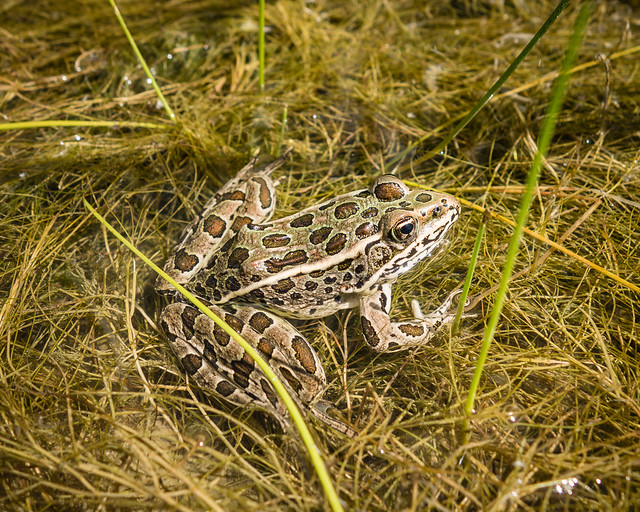
Northern Leopard Frog owe their name to the dark round spots on their green and brown back and legs. Prominent light-coloured folds of skin run down either side of their back, and they have a white belly. They are a medium-large frog, up to 11 cm in length.

Northern Leopard Frog are found near ponds and marshes across Canada and in most parts of the United States. They can be found as far north as Great Slave Lake and in the mountains. They are also known as Meadow or Grass Frog because they sometimes hop up onto lawns and golf courses in the summer when they've finished breeding.

Northern Leopard Frog will eat anything they can fit in their mouth and have been known to eat small birds and snakes. They sit still, wait for their prey, and then leap and grab it with their long, sticky tongue.

Wood Frog
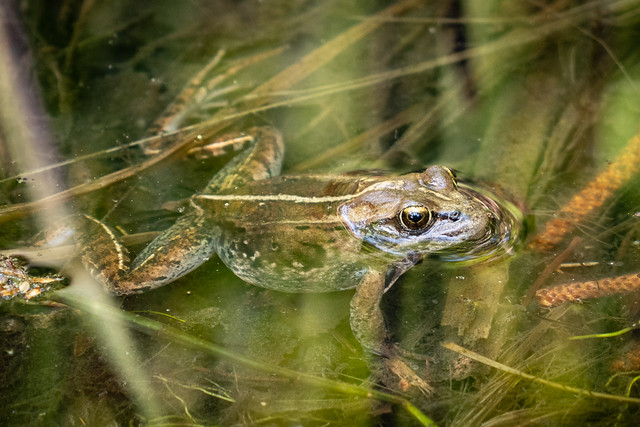
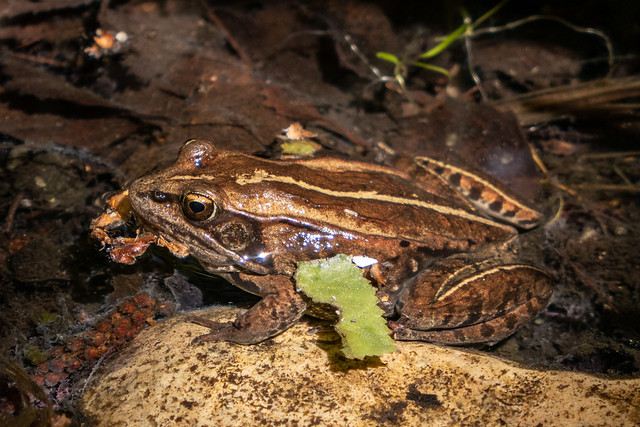
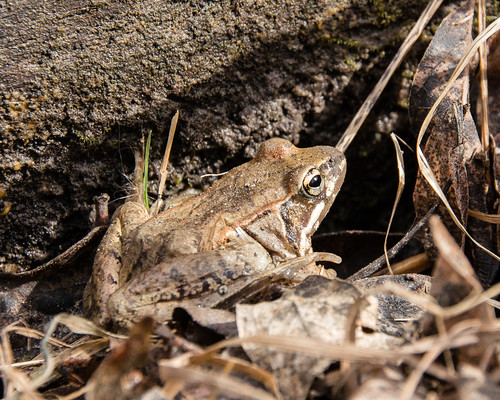
Wood Frog are reddish-brown, medium-sized (3-8 cm long) frogs with prominent ridges on their back, a black mask over their eyes, and a white belly. Some have a white stripe down their back. They can change colour very rapidly, turning dark when cold to absorb more heat.

Wood Frog are found in every province and territory of Canada as well as the northeastern and central United States. They are the only frog found north of the Arctic Circle and are one of the few frogs found in Alaska. They prefer moist woodland areas and hibernate under the leaf litter covering the forest floor.

Like several northern frogs, including the Boreal Chorus Frog, Wood Frog tolerate below-zero temperatures by increasing the amount of glucose in their blood, which lowers the freezing point and stops ice crystals from forming.

Male Wood Frogs announce the start of the early spring breeding season with small clucking sounds. Over a short 1-2 week period, the frogs will mate and the females will each attach up to 2,000 eggs to underwater vegetation. The tadpoles eat plants, while the adults use their long, sticky tongue to capture insects, spiders, slugs, worms, and snails.

Wood frog

Canadian Toad
Canadian Toad are found in river valleys and around lakes in the grasslands, aspen parklands, and boreal forest of the Canadian prairies and south to the Dakotas and Minnesota. They’re medium-sized (up to 9 cm) and grey-green to brown with brownish-red warts. Unlike the Great Plains Toad, they have grey spots on their light-coloured belly and the raised ridges on their head join to form a bump between their eyes.

Canadian Toad are easiest to spot in the spring when they congregate at breeding ponds. The males call to the females with a high-pitched trill that repeats every 15-20 seconds. Once breeding season is over, the toads spread out into the grasslands and aspen parklands, although they generally stay close to water. Their mottled earthy colors are good camouflage.

Canadian Toad hibernate underground below the frost line in burrows they've dug using the bony lumps on their rear legs.

Great Plains Toad
Great Plains Toad are medium-large (up to 11 cm), ranging in colour from pale brown-grey to olive, with dark blotches and numerous small warts. Unlike the Canadian Toad that share the same habitat, Great Plains Toad have a solid white belly and the L-shaped ridges around each eye fuse in a V rather than a lump between the eyes.

Great Plains Toad can be found in the grasslands of southern Alberta, Saskatchewan, and Manitoba and south into the central plains of the United States. They breed in temporary pools, ditches, and dugouts, laying long strings of up to 20,000 eggs. The eggs hatch in about 2 days and the tadpoles turn into frogs after 6 weeks.

Great Plains Toad hibernate in underground burrows from October to April. They are more active at night and escape the heat of the day by digging shallow burrows in loose soil. During a severe drought, they can remain inactive underground for extended periods of time.

Great Plains Toad have large home ranges and can travel over a kilometer between breeding sites, summer habitats, and hibernation sites. When threatened, they puff themselves up with air, lift themselves up on all 4 legs, and lower their head. Poisonous secretions in their warts and the large glands behind their eyes help to deter predators.

Plains Spadefoot Toad
Plains Spadefoot Toad can be found on short-grass prairie from southern Alberta, Saskatchewan, and Manitoba south through the central plains to New Mexico, Oklahoma, and West Texas. They have a round body (up to 6.5 cm), short legs, a bony lump between the eyes, and a vertical pupil. They are tan to dark brown with small orange/yellow spots and a white belly. They often have 4 white stripes down their back.

Plains Spadefoot look like a frog. Unlike the Canadian Toad and the Great Plains Toad, their skin is relatively smooth and moist. They have a vertical rather than a horizontal pupil and lack the large parotoid glands behind the eyes.

Plains Spadefoot are hard to spot as they are nocturnal and spend much of their time buried in the sand to conserve moisture. They come out at night to hunt for beetles, crickets, and grasshoppers. Plains Spadefoot tunnel backwards using the sharp knobs (or spades) on their hind feet. Their tunnels can extend as much as 1 meter – no wonder they prefer sandy or gravel soil that is easier to dig.

See Also
10 Surprising Facts about Frogs and Toads

Saskatchewan’s Snakes

Nature Companion, a Comprehensive Nature App for Canada's four Western Provinces


You can follow EcoFriendly Sask by liking us on Facebook, following us on Twitter, or by email (top right corner).